
Rolling Admissions for Engineering: How It Works and When to Apply


Rolling admission means a school reads your application as it arrives instead of waiting for one deadline, and in engineering that makes timing part of your application. Seats and scholarship money are handed out as decisions are made, so an early, complete file meets more open places than a late one. If you want to lead in AI and advanced technology, the practical move is to prepare your materials first, apply early to the programs you want most, and pair them with a program built around your career goal, such as the accredited degrees we offer at Metapilot Academy in Barcelona.
This guide explains the process in plain words, shows how a typical engineering timeline plays out, lists what you will usually need to send, and covers the questions applicants ask most.
TL;DR
Rolling admission means applications are reviewed in the order received, and decisions typically arrive within 4 to 6 weeks.
Applying early matters most in engineering, because seats and aid shrink as the cycle goes on.
A school can use rolling admission overall and still set firm deadlines for selective majors, so read the engineering page, not just the university page.
Rolling is not easier or harder by itself: your odds depend on the program’s size, the strength of the applicant pool and the seats left when you apply.
Build your transcript, recommendation letters, essay and any test scores before the window opens, then submit as early as a polished file allows.
Table of Contents
What rolling admission means
Most people picture college admissions as a single deadline, followed by a long wait while the school reads every file at once. Rolling admission works differently. The school opens an application window, reviews each file when it comes in, and sends a decision soon after. The Princeton Review describes it as something a college does, not something an applicant picks: the school evaluates applications as they are received until all slots are filled. Colleges with a regular deadline, by contrast, wait until that date to start reading.
Three features matter for you as an applicant:
Decisions come in a stream. The College Board says you can expect to hear back within about 4 to 6 weeks, though each school sets its own pace.
The window is long. It often opens in the fall and runs for months, but the number of seats does not stretch with it.
Decisions are not binding. Unlike early decision, where an acceptance commits you to attend, rolling admission lets you apply to several schools and compare offers.
How it differs from early action and regular deadlines
Early action is a program where you apply by an early date and hear back sooner, without being committed to enroll. Early decision is the binding version. Regular decision is a fixed deadline with decisions released together. Rolling admission sits beside these: there is no single date, and the school keeps issuing answers until the class is full.
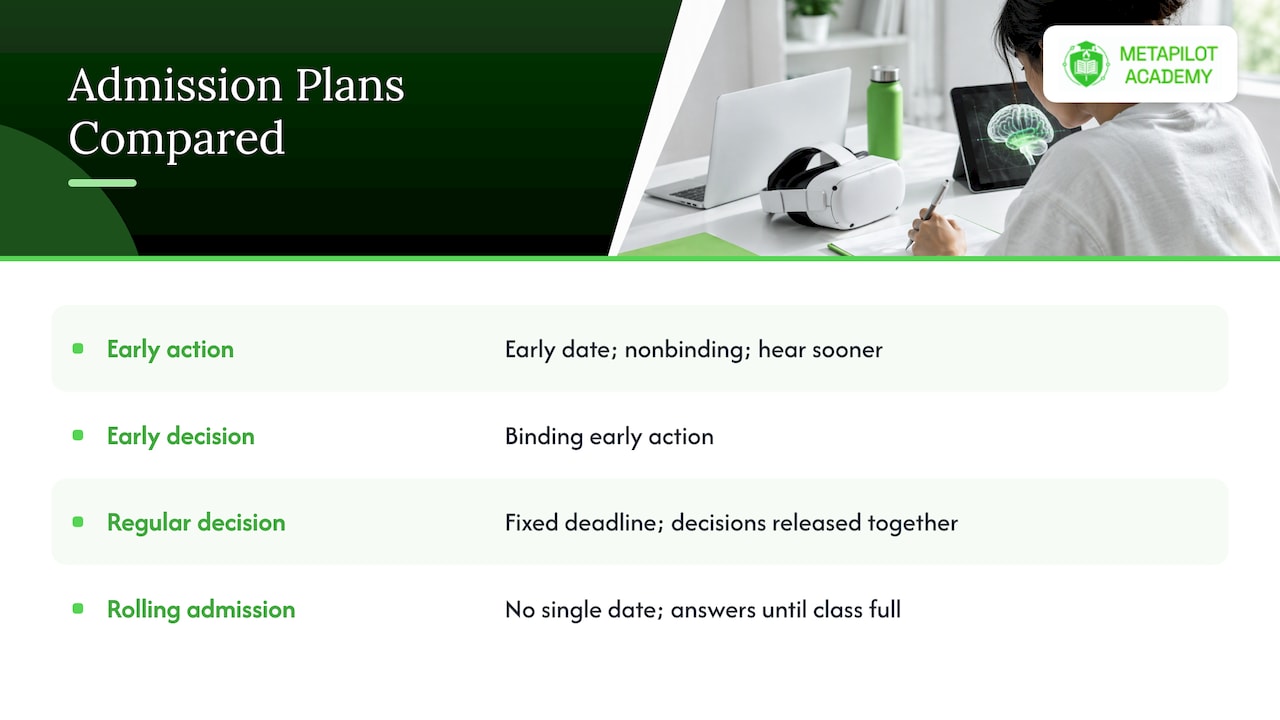
Some applicants ask whether early action or rolling is “better.” They solve different problems. Early action is a date you aim for. Rolling is a process you learn to work with, and in practice the best strategy is the same: send a complete file early.
Why timing matters more in engineering
Engineering programs have labs, studio space and faculty advising to ration, so their capacity is limited. That is why the early part of a rolling window is so valuable.
The College Board notes that chances are far better when you apply early, because there is more space and less competition earlier on. Research.com, in its engineering rolling-admission overview, describes the same pattern: early applicants see the fullest range of seats and scholarship funds, mid-cycle applicants trade preparation time against shrinking openings, and late applicants face a higher risk of rejection or waitlisting because seats and aid are depleted.
A simple way to picture it:
When you apply | What is usually available | What to expect |
Early in the window | Most seats, most scholarship money | A fair read against a still-forming pool |
Middle of the window | Fewer seats, some aid left | You gain prep time but compete for what remains |
Late in the window | Few seats, limited aid | Higher chance of waitlist or denial |
The exact dates differ by school and by year, so treat the table as a pattern, not a calendar. Always confirm the current window on the school’s own admissions page.
The engineering catch: program-level deadlines
A university can advertise rolling admission and still treat certain majors differently. Empowerly warns that majors such as engineering, nursing or business may carry firm deadlines even when the school is rolling overall. Its advice is to check program-specific pages and apply as soon as the window opens if your intended major is selective.
This is the single most useful habit for engineering applicants: find the engineering department’s page, read the deadline language, and note whether the major itself is capped or has its own priority date.
Is rolling admission harder to get into?
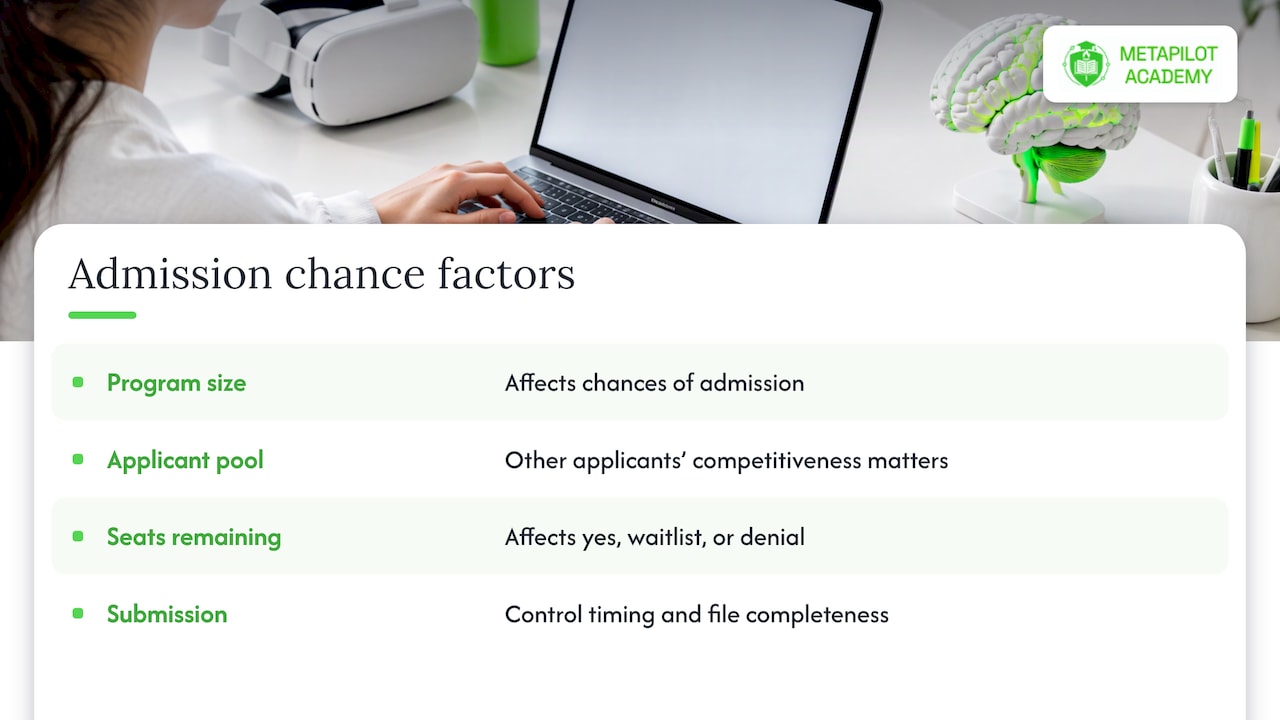
Not by design. Research.com argues that rolling admission is a procedure, not a lower or higher bar. Your chances depend on three things: how large the program is, how competitive the other applicants are, and how many seats remain when your file is read.
That means the same GPA can get a yes in October and a waitlist in March. You cannot change the pool, but you can control when you enter it and how complete your file is the day you submit.
What you will usually need to submit
Requirements vary by school, so use the engineering page as your checklist. Most undergraduate engineering applications ask for a similar core:
Transcript. Your official record of courses and grades. Engineering programs look closely at math and science, such as calculus, physics and chemistry.
Recommendation letters. Short statements from a teacher or counselor. The College Board advises you to request them early, since writers need time.
Essay or personal statement. A short piece on why you want to study engineering and what you have built, fixed or tried.
Test scores, if the school asks for them. Some schools require them, others make them optional. Our partners-free reading list is short here: if you plan to sit an entrance exam, a guide to standardized university admission tests helps you choose and schedule one before the window opens.
Application fee or a fee waiver. Check the school’s page for the current amount and for waiver rules.
The lesson for rolling schools is simple: the clock starts when your file is complete, not when you click submit. A missing letter or score can push your decision to a later, tighter part of the window.
A step-by-step plan for a rolling engineering application
List your schools and sort them. Put your top picks in one group and backups in another. The College Board suggests that if a rolling school is a top choice, apply early, while lower-priority schools can wait a little longer.
Check each engineering page for its own deadline. Look for priority dates, capped majors and extra forms.
Ask for recommendation letters now. Give writers a list of your projects and the deadline you are aiming for.
Draft your essay before the window opens. A finished draft lets you submit the day the portal opens.
Send test scores early if you are submitting them. Score reports take time to arrive.
Submit, then track. Keep a simple sheet with the school, date submitted, date decided and any aid deadline.
Respond to scholarship and housing steps quickly. Aid and rooms can also run out on a rolling basis.
Where it goes wrong: applying to ten schools in the last week, sending a rushed essay to all of them, and discovering that two had program deadlines you never read.
Rolling admission for graduate and advanced programs
Rolling admission is common beyond undergraduate degrees. Master’s and PhD applicants in engineering, AI and related fields often meet it too, and the same logic applies: seats and funding are filled in order, so earlier is stronger.
Graduate files look different, though. Instead of a high school transcript, you will usually show an undergraduate degree, grades in relevant courses, a statement of purpose and sometimes work or research samples. A statement of purpose is a one- or two-page essay explaining what you want to study, what you have already done and why this program fits. If you are heading toward an AI master’s, our guide to the AI master’s statement of purpose shows how to build it from evidence rather than adjectives, and our overview of AI master’s admission requirements explains how to close gaps in your course history.
If you are an engineer weighing a leadership route, MBA versus engineering management lays out the choice for the next three to five years.
Funding: apply early for aid too
Because scholarship money can shrink as the cycle runs, the timing advice applies to funding as well as seats. Gather your financial forms and scholarship materials while you prepare the application, not after the offer arrives. If you plan to study aerospace or related fields, see our guide to aerospace graduate scholarships for ways to fund a master’s or PhD, and our scholarships page for what Metapilot Academy offers.
Perspective
Rolling admission rewards the applicant who is ready, and we think the same is true of a career in advanced technology. The tech industry is going through layoffs, and many talented engineers are asking how to level up their skills in a direction employers still need. Our answer is to pair a rigorous, accredited degree with real projects. At Metapilot Academy, our programs are co-designed with top global corporations and research centers, and our practical projects are built to give students direct recruitment pathways. We admit select, high-talent students, and those students gain access to industry demo days and funding opportunities. That is the gateway we want to open for engineers, biohackers, corporate professionals and first-time degree seekers. Whatever program you choose, our advice is the same: prepare your file early, ask for your letters early, and apply to the programs that match where you want to lead. We would love to see you among the Metapilots. Metapilot Academy Team
Where Metapilot Academy fits
If your goal is to lead in AI, neurotechnology, aerospace, biotech or related fields, our accredited programs run from Bachelor’s through MBA, Master’s and PhD, in flexible online and in-person formats. Our projects are co-designed with corporations such as Boeing and NASA, and students can join industry networking, demo days and recruitment events.
The published entry costs are a 1 € one-off joining fee and a 499 € one-off registration fee. Program tuition is not published on the pricing page, so use it to see which tracks fit you. You can compare the Master in applied Artificial Intelligence and our other programs, or start from our pricing and plans page.
[
If you are an engineer who wants a specialist route, our Master in Neurotechnology is a good place to begin. If you are a working professional, our MBA and Executive Boardroom tracks are designed for you, and our AI Agent microcredentials, short certifications focused on one skill, offer a gateway to deeper skills. Ready to move? Explore our programs and apply.
How to compare programs when you are applying in several places
When you hold several offers, compare them on things you can verify:
Accreditation. This means an official body has reviewed the program against standards. It affects whether employers and other universities recognize the degree.
Outcomes. Look at how a program reports graduate placement. Our guide to reading graduate placement rates gives six checks.
Hands-on work. Ask what real projects you will complete and with whom.
Cost and aid. Compare tuition, fees and scholarship terms in writing.
Fit with your target job. If you aim for aerospace, see how student internships are approached, and if defense AI interests you, see how to pick defense AI programs.
FAQ
Is rolling admission harder to get into?
Not because of the format. Acceptance depends on the size of the program, the strength of the applicant pool and the seats left when your file is read. Applying early usually gives you the widest choice of open seats.
Is early action or rolling admission better?
They are different tools. Early action is a set early deadline, while rolling admission is a process where schools decide as files arrive. For a top-choice school with either one, the advice is the same: submit a complete application as early as you can.
How long does a rolling admission decision take?
The College Board says you can typically expect an answer within 4 to 6 weeks. Individual schools set their own timelines, so check the admissions page for the one you are applying to.
Do engineering majors have separate deadlines at rolling schools?
Sometimes. A university may be rolling overall while holding firm deadlines for selective majors such as engineering. Read the engineering department’s page and apply as soon as the window opens if your major is competitive.
Can I apply to several rolling schools at once?
Yes. Rolling admission decisions are not binding, so you can apply broadly and compare offers. Prioritize your top picks first and keep a tracker of every deadline.
Sources
Recommended
Comments