
Employer Sponsorship for a Master's: How to Get Your Degree Funded


Employer sponsorship for a master’s means your company pays some or all of the cost of a graduate degree, usually because the degree makes you more valuable in your job. The best way to win it is to choose an accredited program that clearly matches a business need, put the numbers in front of your manager, and read the repayment terms before you sign. A program built around real industry projects and offered online or in person, like the master’s and MBA tracks at Metapilot Academy, makes that case easier because you can keep working while you study.
TL;DR
Employer sponsorship comes in several forms: direct payment, reimbursement after each course, loan repayment help, or paid educational leave.
Companies typically ask for about a year of tenure, a job-relevant degree, minimum grades and a promise to stay after you finish.
Leaving early can trigger repayment, so read the clawback clause (the part of the agreement that lets the company take money back) before you start.
Your pitch should tie the degree to a business result, show the full cost, and propose a schedule that protects your work.
Tell your school’s financial aid office about any employer money, since it can affect other aid.
Table of Contents
What employer sponsorship actually covers
The Education Finance Council, a US association of education finance organizations, describes employer education benefits as arrangements where the employer pays eligible costs directly or reimburses you, covers a large share or all of a degree (often with a required period of continued employment), makes payments toward your education loans, or gives paid time off to study. These are different from scholarships and grants, which generally do not have to be repaid if you meet the program’s requirements, and from federal loans, which are borrowed money.
The same page lists other forms you may meet: university partnerships that give employees a tuition discount, employer-funded scholarships, support for licensing and exam fees, and internship or rotation arrangements.
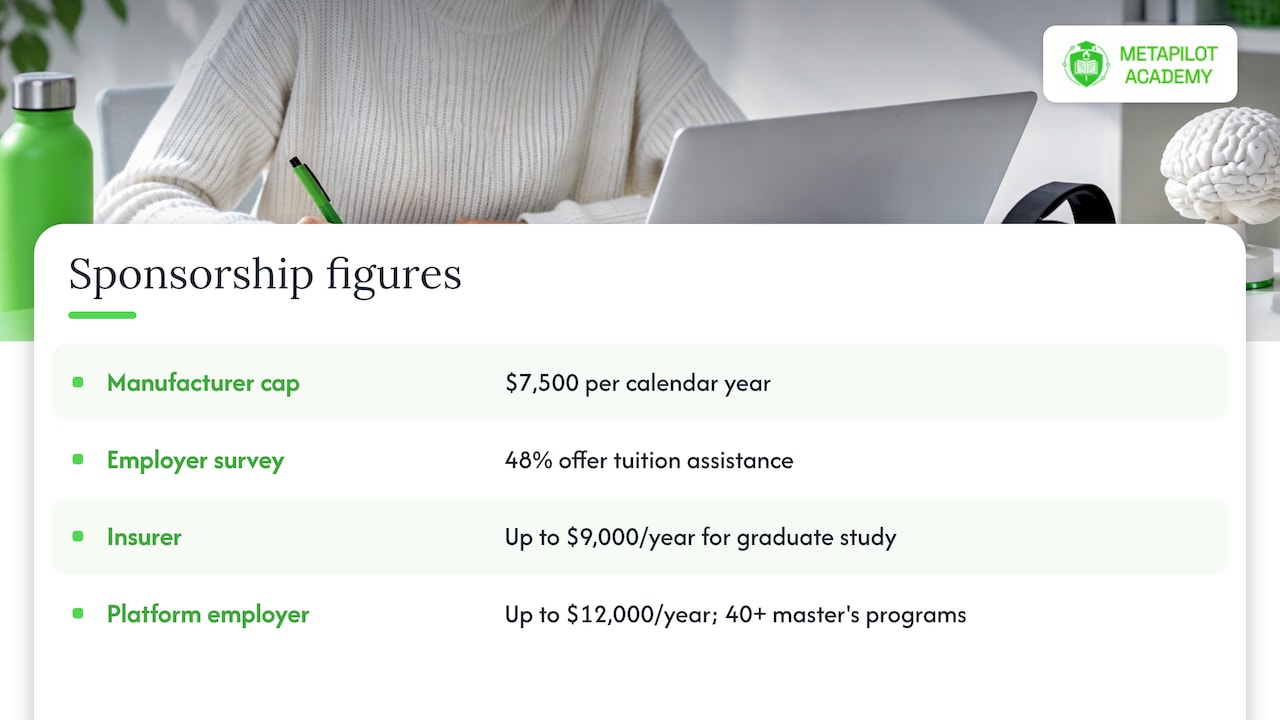
What counts as covered varies a great deal. One large manufacturer’s policy covers tuition, mandatory fees, required textbooks and software, preparatory and exam fees and lab fees up to $7,500 per calendar year, and eligible fields typically include business, computer science, engineering, management and technology. That is one company’s 2010 policy, so treat it as an example of the structure, not a current standard.
How common is it? A 2023 industry survey of employers, reported by WorkLife, found 48% offer tuition assistance of some kind. In the same report, one insurer covered up to $9,000 a year for graduate education. Another employer, in a program run with an education platform, contributes up to $12,000 a year toward more than 40 master’s programs, according to Fortune.
The takeaway: ask what your company calls the benefit (tuition assistance, tuition reimbursement, education assistance), then ask for the written policy. Many employees never request it because they assume a master’s is too big to qualify.
Direct payment versus reimbursement
These two models feel very different in your bank account.
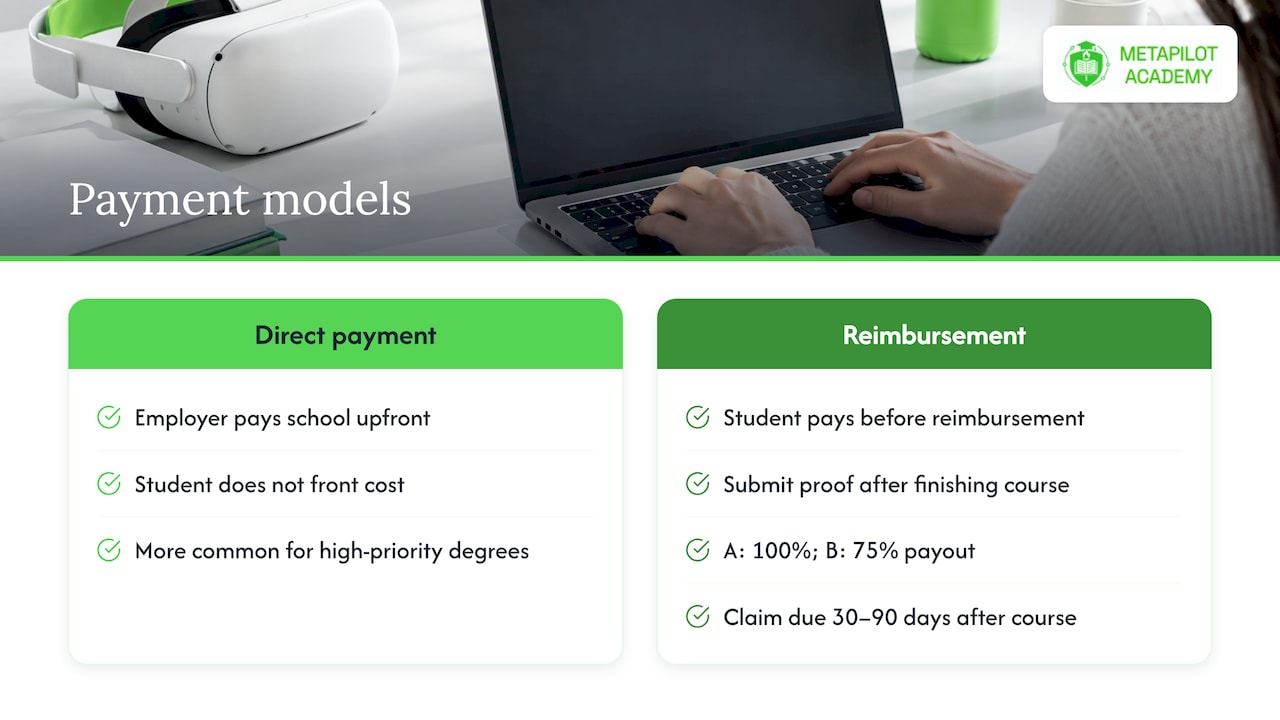
Direct payment means the company pays the school, so you do not front the money. It is more common for high-priority degrees.
Reimbursement means you pay first and get money back after you finish a course and submit proof. Reimbursement is often tied to your grade. A review of employer education policies by the Knowledge Industry, an academic research group, found grade-linked payouts such as 100% for an A and 75% for a B, with claims typically due within 30 to 90 days of finishing a course.
If your employer reimburses, plan your cash flow. Graduate courses are billed per term, and you may carry the cost for several months before the money comes back.
Who qualifies and what employers ask in return
The same review found most employers require full-time status, about one year of tenure and a minimum performance-review score. Nearly all require you to stay employed while you study, and often for at least a year after you finish, or you face repayment.
Seniority can matter too. In the manufacturer’s policy above, every employee could use the benefit for undergraduate study, but a functional master’s required a higher job grade, and an MBA required a higher grade plus a top performance rating, at a US regionally accredited school. Regional accreditation is a quality review of the whole institution by an independent body. Companies often use it as their test of whether a degree counts.
Typical conditions at a glance
Condition | What it usually looks like |
Tenure | About one year with the company before you apply |
Performance | A minimum rating on your latest review |
Relevance | The degree must relate to your role or the company’s needs |
Accreditation | The school must be accredited |
Grades | Payment tied to your grade, often a B or better |
Retention | Stay employed during and often after the degree |
The relevance test is where technical students have the advantage. A master’s in applied artificial intelligence, neurotechnology or mobility technology is easy to connect to a product roadmap, a lab or a hiring plan. If you work in a field where the company is building these skills, you are asking it to invest in capability it already wants.
How to make a convincing case
A manager approves a budget request when it looks like a business decision, not a personal favor. Build your request in five parts.
Name the business problem. Not “I want a master’s,” but “our team needs someone who can design and deploy AI agents (software that plans and carries out tasks on its own) for our customers.”
Show the full cost. Tuition, fees, books and any software, per term and in total, so nobody discovers a surprise later.
Map the skills to your projects. Name two or three upcoming projects where the new skills apply. Programs where students work on real industry problems, such as the industry-led master’s and capstone projects we describe, give you something concrete to point to. A capstone is a final project that applies what you learned to a real problem.
Protect your workload. Propose a part-time or online schedule so your current work does not suffer. Our guide to finishing a part-time AI master’s in 24 months while working shows how that can be structured.
Offer something back. Agree to a stay-after-graduation period, to teaching colleagues what you learn, or to leading a pilot project.
Use the evidence employers respond to
Hiring and retention numbers move budget holders. A Lumina Foundation study of Cigna’s education reimbursement program, which paid up to $8,000 a year for graduate courses, found a 129% return on investment: for every $1 invested, the company avoided an additional $1.29 in talent-management costs. Entry-level and mid-management participants also earned a 43% incremental wage increase over three years compared with non-participants. Waste Management’s chief human resources officer said enrolled employees were 60% less likely to leave and 3.3 times more likely to be promoted.
Bring one or two of these figures, and say plainly that they come from other companies’ programs, not a guarantee for yours.
The approval process step by step
Most companies run some version of the same workflow.
Find the policy. Check the HR portal or employee handbook, or ask HR for the “tuition assistance” or “education assistance” policy.
Get pre-approval in writing. One defense contractor’s procedure, from its January 2026 document, requires written HR approval before the course begins. Enrolling first can cost you the benefit.
Submit the course details. Expect to give the program, school, cost and a short statement of how it relates to your role.
Collect your documents. Keep receipts and official grade reports. Reimbursement is processed only after they arrive.
Claim on time. Missing a 30 to 90 day window can forfeit the payment.
Program fit matters at step 3. HR checks that the school is accredited and that the degree is eligible. If you are weighing an accredited program in AI, neurotechnology or business, you can compare options on our programs page before you file.
Terms to read before you sign
This is the part that decides whether sponsorship is a gift or a debt. The Education Finance Council advises checking eligibility rules, covered expenses, grade requirements, how payment works, tax treatment and any requirement to stay employed, plus whether you might have to repay some or all of the benefit if you leave, change roles, withdraw or fall short of requirements.
Repayment and clawbacks
A clawback is a clause that makes you pay back money if you leave early. Real examples:
The defense contractor’s procedure requires employees who leave voluntarily within 24 months of receiving benefits to repay 1/24th of the total for each month short.
A 2026 tuition guide reports that many US programs ask for 100% repayment if you leave within 12 months and often 50% for months 13 to 24, collected through payroll deductions from your final paycheck.
Before signing, ask: What triggers repayment (resignation, layoff, termination)? Is the amount prorated, meaning reduced over time? Does it include only tuition, or also fees and books? Does it apply if you fail a course?
State law can change the picture
Rules differ by state. California, for example, limited “stay or pay” contracts from 1 January 2026 but kept an exception for tuition-repayment agreements covering a transferable credential, such as an accredited master’s not required for your current job. To qualify, the agreement must be offered separately from your employment contract, state the repayment amount up front, not exceed the actual tuition cost, be prorated over the service period, and not demand repayment after most terminations. Under that exemption, according to the same analysis, resignation, layoff or a performance-based dismissal cannot trigger repayment, but dismissal for misconduct can.
That is California’s rule. Other states differ, so if your agreement looks unusually one-sided, an employment law attorney can review it before you sign.
Taxes
Under IRS rules, the amount an employer can provide tax-free is limited. The defense contractor’s procedure describes a federal threshold of $5,250 per calendar year above which assistance is taxable. Separately, IRS Publication 970 explains that a graduate tuition reduction from a school is tax-free only when the student does teaching or research for that school; other graduate tuition reductions count as income. If your employer’s benefit exceeds the threshold, ask payroll how the excess will appear on your pay stub, and talk to a tax professional about your situation.
Tell your school
The Education Finance Council recommends telling your school’s financial aid office about any employer benefit, because it can explain how that money interacts with scholarships or loans. Many students skip this step.
Combining employer money with scholarships
Employer support rarely has to be all or nothing. If your company covers part of the cost, scholarships can close the gap, and a partial sponsorship is easier to approve than a full one. Our guides on international student financing for a master’s and aerospace graduate scholarships cover how to layer funding sources. If you are in a technical field, it also helps to read about employer-backed AI programs for engineers so you can present a clear route to your manager.
A closer look at Metapilot Academy
Metapilot Academy is an accredited institution based in Barcelona, offering MBA, master’s, bachelor’s and PhD programs plus shorter technical certifications in AI, neurotechnology, aerospace, mobility, space and biotech. Programs are offered online and in person, and projects are co-designed with corporations such as Boeing and NASA, so the work you present to your employer is tied to real industry problems.
For sponsorship requests, the published fees are simple to put in a budget form: a one-off registration fee of €499 and a one-off joining fee of €1, listed on our pricing plans page. Program tuition is not published there, so request it when you prepare your cost summary. Scholarships are also available to help reduce tuition.
Explore the master’s in applied Artificial Intelligence and our full program list to find the track that matches the case you want to make.
[
Our perspective
Employer sponsorship works best when the degree and the job pull in the same direction. We built our programs around that idea: accredited degrees in fast-moving fields, with projects co-designed with corporations such as Boeing and NASA, so what you learn on Monday can show up in your work on Tuesday. Technology teams are changing quickly, and many professionals want to level up their skills without stepping away from their careers. Our online and in-person formats are designed for that, and our rigorous selection process means you study alongside motivated peers who become a lasting professional network. When you talk to your manager, bring a specific project, a clear schedule and a realistic total cost. Then compare sponsorship, scholarships and your own savings, and combine them if you can. We are happy to help you prepare the program details your HR team will ask for. Metapilot Academy Team
FAQ
Can I ask my employer to pay for a master’s if there is no formal program?
Yes. Many companies approve one-off requests when the degree fits a business need. Put the request in writing with the cost, the schedule and what you will do for the company in return, and ask for the approval in writing before you enroll.
How long do I have to stay after my employer pays?
It varies by company. Employer policies commonly require you to stay at least a year after finishing, and some use month-by-month repayment over 24 months. Check your agreement for the exact period and how repayment is calculated.
Is employer-paid tuition taxable?
Under the federal threshold described in one employer’s 2026 procedure, up to $5,250 per calendar year can be provided without being taxed, and amounts above it are taxable. Ask your payroll team how your benefit will be reported and consult a tax professional about your own situation.
Does employer sponsorship affect my financial aid or scholarships?
It can. The Education Finance Council recommends telling your school’s financial aid office about any employer benefit so it can explain how the money interacts with your other aid. Do this before the term starts.
Which master’s degrees are easiest to get sponsored?
Degrees that clearly connect to your current role or the company’s plans, such as business, engineering, computer science and technology, are the easiest to justify. A specialized degree like applied AI or neurotechnology is strongest when you can name the projects where it will be used.
Sources
Recommended
Comments