
NASA Partnership Programs for Students: What Exists and How to Qualify


NASA runs several different student programs, and they are built for different people. OSTEM internships are project-based learning placements. Pathways internships are a paid route toward a federal job. Space Grant funds scholarships and fellowships through universities. Challenges and state programs reach younger students. Most of them require U.S. citizenship and enrollment at a U.S. accredited school. If that is not you, or if you want a degree built around industry projects, there is a second route: an accredited program co-designed with corporations such as Boeing and NASA, like the ones we teach at Metapilot Academy in Barcelona.
This guide sorts the NASA options by who they fit, shows the rules that decide eligibility, and explains how to build a strong application, so you can pick the right door quickly.
TL;DR
NASA’s main student routes are OSTEM internships (project-based), Pathways internships (paid, can lead to a federal job), Space Grant scholarships and fellowships, and team challenges.
Most internships require U.S. citizenship, enrollment at an accredited U.S. institution and a minimum GPA (grade point average, your average grade on a 4.0 scale).
NASA’s International Internship program is not being offered at this time, so students outside the U.S. need another path.
Metapilot Academy offers accredited MBA, Master’s, Bachelor’s and PhD programs plus certifications, with scholarships and practical, industry-led projects.
Table of Contents
The main NASA student programs at a glance
NASA’s own pages split its student offerings by level: high school, undergraduate, graduate and postdoctoral. The table below compresses what the research shows into one view. Always confirm details on the official pages, because schedules and rules change.
Program | Who it is for | What you get |
OSTEM internships | U.S. citizen students, 18 or older by the session start | Project-based work that supports NASA missions, with a stipend |
Pathways internships | U.S. citizens, at least 16 years old | Paid work in a cooperative-education format (study and work alternate) |
Space Grant | Students at member universities | Scholarships, fellowships, research and internship support |
Challenges (HERC, TechRise, Moon Base) | Teams from middle school to college | Hands-on engineering competition |
Texas Aerospace Scholars | Texas high school students | Virtual and residential STEM experiences |
OSTEM internships: project work for students
OSTEM stands for the Office of STEM Engagement, the NASA office that runs education programs. Its internships are for U.S. citizen students and focus on project-based learning: you join a team, own a defined piece of work, and contribute to an agency mission. Most interns receive a stipend that depends on academic level and session length.
The core requirements, per NASA:
U.S. citizenship.
A minimum 3.0 GPA on a 4.0 scale.
Enrollment at an accredited institution (accredited by a body recognized by the U.S. Department of Education).
Age 18 by the start of the session. High school seniors can apply for the summer session that follows graduation.
You apply through NASA STEM Gateway, the agency’s online application portal. Letters of recommendation are not required, which lowers the paperwork but also means your written statement and your project history carry the whole application.
Where applications go wrong
The most common problem is a thin profile. Many applicants list courses and nothing else. A project you built, a model you simulated, code you published or a team you led gives a reviewer something concrete. Build that record before you apply, not after.
Pathways: from internship to a federal job
Pathways is different in kind. It is a cooperative-education program, meaning you alternate between school and paid work. According to NASA’s applicant guide, the requirements include:
U.S. citizenship.
A minimum 2.9 GPA.
Age 16 or older at appointment.
The ability to complete at least 480 work hours before you graduate.
After the initial appointment, Pathways interns can be converted to a full-time NASA position without competing again, a process the guide calls noncompetitive conversion. That is the biggest prize in the program. You apply through USAJOBS, the federal government’s job board, which expects a federal-style resume. These are longer than a typical one-page resume because they list hours, duties and outcomes in detail.
Space Grant: scholarships and fellowships through your university
The National Space Grant College and Fellowship Program is a network of colleges and universities organized into 52 consortia. They fund fellowships and scholarships for students pursuing careers in science, technology, engineering and math (STEM), and they support research and public outreach.
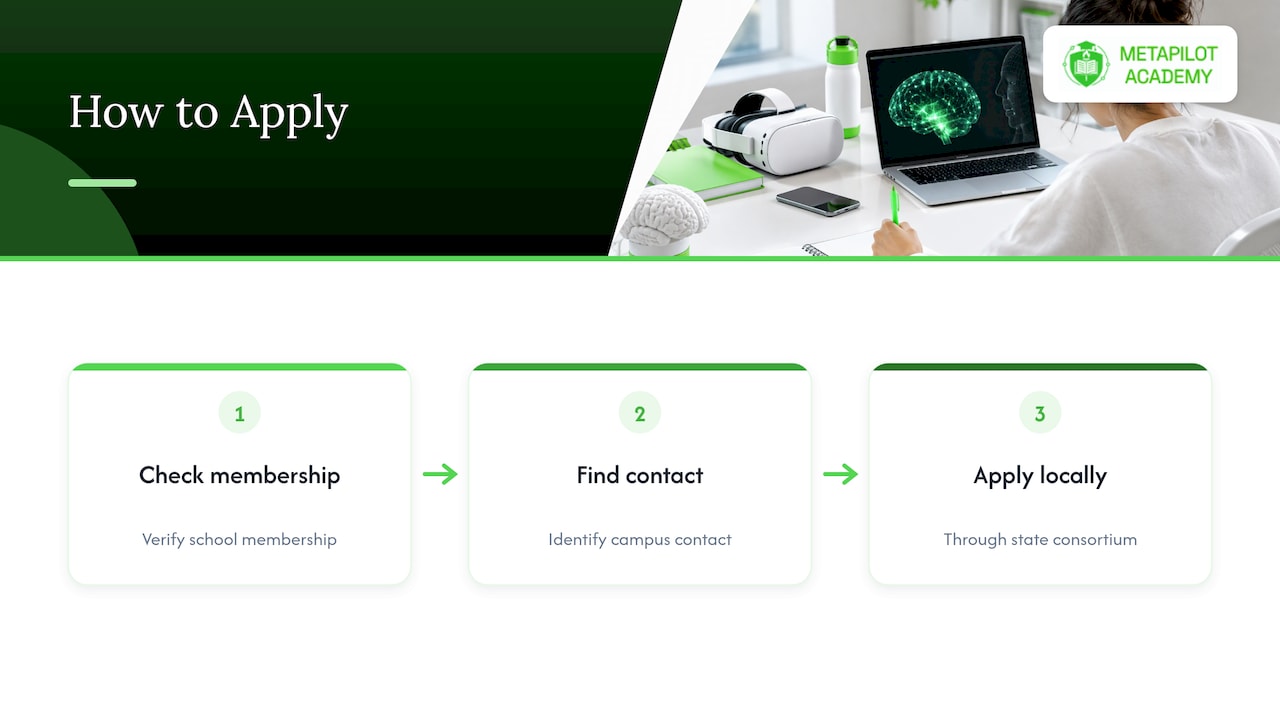
You do not apply to NASA headquarters. You apply through the consortium in your state, usually via a member university. One example, Minnesota’s consortium, lists scholarships, NASA center internship support, NASA-related research and extracurricular aerospace teams for students at affiliate schools. The same page notes that awards frequently carry a matching-funds requirement, so federal money is combined with state and institutional money. Practically, that means the first step is checking whether your school is a member and who the campus contact is.
Younger students: challenges and state programs
If you are still in school, internships may be a year or two away. In the meantime, NASA’s challenges are the best entry point. HERC is open to middle-school, high-school and college teams. TechRise serves grades 6 to 12. The Moon Base Challenge is for high-school and post-secondary students. Texas students can also look at Texas Aerospace Scholars.
On the popular question of whether a 15-year-old can intern at NASA: not through the OSTEM route, which requires age 18 by the session start. Pathways sets its floor at 16. A 15-year-old’s best move is a challenge team or a state program, plus building projects that will stand out at 16 or 18.
If you are not a U.S. citizen or not eligible
Citizenship is the hard line. NASA’s International Internship program, known as I², is not being offered at this time. NASA’s FAQ points international students toward collaborative challenges and citizen science instead of direct internships while the program is paused.
That leaves many capable engineers, career changers and biohackers (people who apply engineering and biology methods to human performance and health, often outside a traditional lab) asking what to do next. Three habits help:
Learn how the space sector actually works. A comparison of how Mars missions differ across NASA, SpaceX, China and Europe shows how many agencies and companies need the same skills.
Build proof of skill: projects, certifications and a portfolio.
Choose a program whose industry connections are open to you wherever you live.
Why an industry-linked degree can work alongside, or instead of, a NASA internship
NASA internships are competitive and capped by eligibility rules. A degree designed with industry input gives you a project record that supports any application: NASA, a major aerospace manufacturer, a defense contractor or a biotech company.
The qualities that matter to hiring teams are consistent: practical projects, a network, and a credential from an accredited institution (one reviewed by an official body that confirms its standards). Our articles on mentor-backed NASA internships and aerospace student internships go deeper on how to assemble that record, and our piece on Boeing university partnerships looks at paths beyond internships.
Funding the degree
Cost matters as much as access. NASA’s own stipends and Space Grant awards reduce costs for those who qualify. Metapilot Academy also has scholarships to reduce tuition, and our guide to aerospace graduate scholarships covers funding for a Master’s or PhD. Apply to every funding source you qualify for, and start with the ones tied to your school.
A practical plan by profile
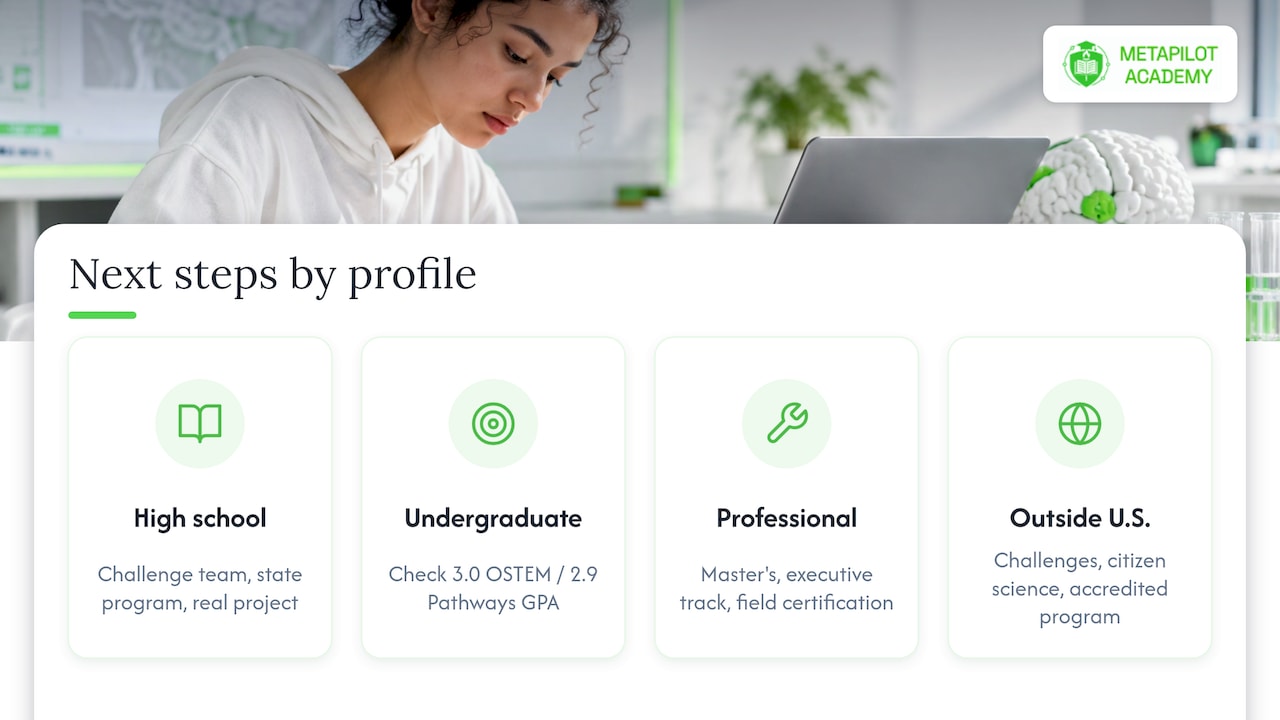
High school student. Join a NASA challenge team, check your state program, and build one real project. Apply for a Pathways or OSTEM internship at 16 or 18 as the rules allow.
Undergraduate. Check your GPA against the 3.0 (OSTEM) or 2.9 (Pathways) minimum, ask your school whether it belongs to Space Grant, and prepare a federal-style resume for USAJOBS.
Engineer or corporate professional. Internships are aimed at students, so look at a credential that upgrades your standing: a Master’s, an executive track or a certification in a field such as neurotechnology or advanced air mobility (drones, electric air taxis and the airports built for them, called vertiports).
Student outside the U.S. Use challenges and citizen science, and invest in an accredited program with international access.
Perspective
We teach people who want to lead in AI and advanced technology, and we hear the same story: the NASA name is a dream, but the entry rules are narrow. Citizenship, GPA minimums and a single application window leave out talented people. Our programs are co-designed with top global corporations and research centers, with practical projects that mirror real engineering problems and direct recruitment pathways. We admit select, high-talent students so that demo days, recruitment events and funding opportunities reach people who will use them. Whatever route you take, the principle is the same: a degree is strongest when it produces proof of work and a professional network. That is what we have designed our MBA, Master’s, Bachelor’s, PhD and certification programs to do. Metapilot Academy Team
Explore Metapilot Academy programs
If you want accredited training in AI, neurotechnology, aerospace, biotech or advanced air mobility, our program list covers the Master in Neurotechnology, the Master in applied Artificial Intelligence, an AAM certification on drones, flying cars and vertiports, and AI agent microcredentials (short, focused credentials). Degrees run from Bachelor’s to PhD, in online and in-person formats, with practical projects co-designed with corporations.
[
Fees we publish: a joining fee of €1 and a registration fee of €499, both one-off. Program tuition is not listed publicly, so see the pricing page for the programs and plans. When you are ready, you can apply from the Metapilot Academy site.
FAQ
Who is the youngest person who can intern at NASA?
Pathways interns must be at least 16 at appointment. OSTEM interns must be 18 by the session start, although high school seniors may apply for the summer session right after graduation. Younger students can join challenges such as TechRise, which serves grades 6 to 12.
What is the NASA Space Grant Consortium?
It is a national network of colleges and universities with 52 consortia. They fund fellowships and scholarships for STEM students and support research and outreach. You apply through your state’s consortium, usually via a member university.
Can I get a NASA internship if I am not a U.S. citizen?
NASA internships generally require U.S. citizenship, and the International Internship program is not being offered at this time. International students can take part in collaborative challenges and citizen science, and can build a portfolio through an accredited program elsewhere.
Do NASA interns get paid?
Most NASA interns receive a stipend that depends on academic level and session length, and Pathways internships are paid positions. Check the official internship page for the current stipend details for your session.
Sources
Recommended
Comments