
Project-Based Engineering Degrees: How to Choose One

A project-based engineering degree teaches mainly by having you solve real design problems, alone and in teams, instead of mainly sitting in lectures and sitting exams. The best ones tie those projects to industry problems, so your coursework becomes evidence of what you can do. At Metapilot Academy, our accredited Bachelor’s, Master’s, MBA and PhD programs in AI, neurotechnology, aerospace, biotech and related fields are built around practical, industry-led projects co-designed with corporations such as Boeing and NASA. Below you will find how these degrees work, how to judge one, and what to check on accreditation and cost.
TL;DR
A project-based degree replaces much of the lecture-and-exam routine with team and individual projects that are graded as part of your degree.
Projects build communication, teamwork and professional responsibility, and roughly 60% of the learning outcomes in the units studied were still technical.
Judge a program by who sets the project briefs, how projects are assessed, and what happens to your work afterwards, not by the word “hands-on”.
Check accreditation and whether the degree is recognized in the country where you want to work.
Our programs pair projects with industry partners, scholarships and recruitment events. Start at our programs page.
Table of Contents
What a project-based engineering degree actually is
In a traditional engineering course, you learn theory in lectures, practice it in problem sets, and prove it in exams. In a project-based degree, a large share of your grade comes from projects: open-ended problems where you must decide what to build or design, plan the work, and defend your choices.
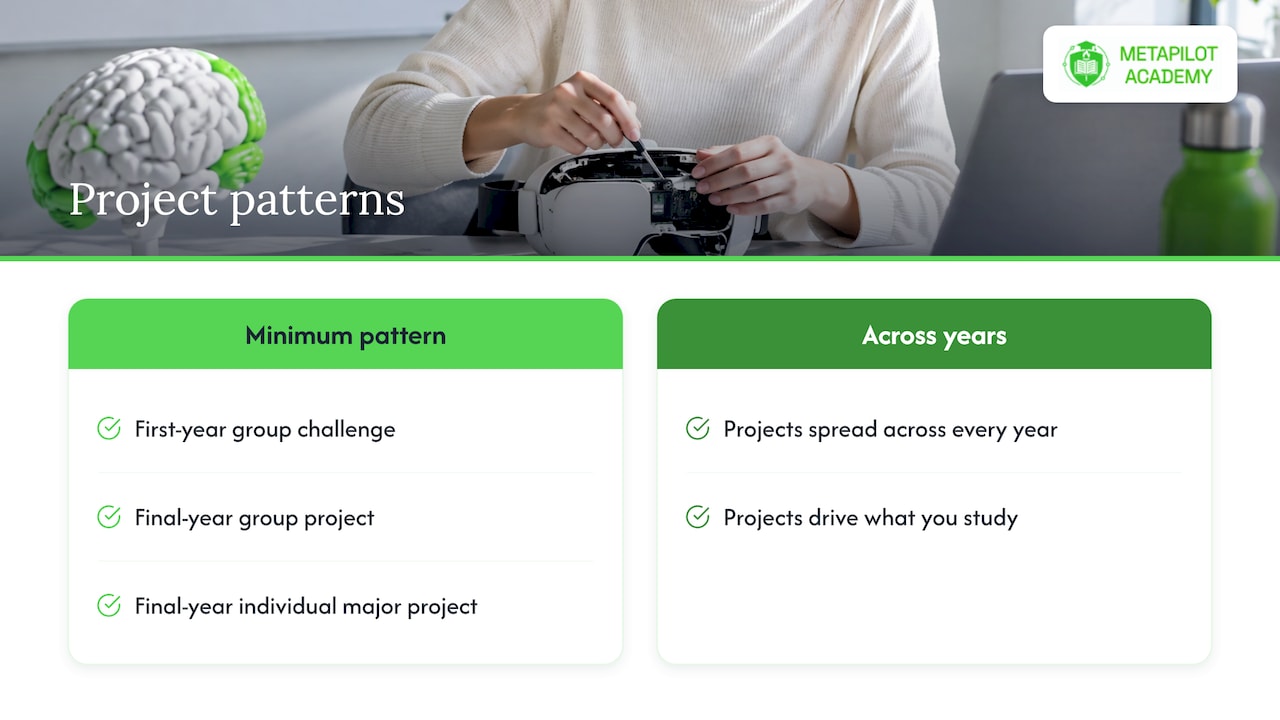
Most engineering programs include some project work, so the useful question is how much and how serious. A common minimum pattern, described in a 2010 MIT white paper on UK engineering education, is a group challenge in the first year, then a group project and an individual major project in the final year. Programs that go further spread projects across every year and let them drive what you study.
One finding in that paper surprises many applicants. Among the highly regarded examples the author reviewed, fewer than half involved any practical or hands-on element. In other words, “project-based” is as much about design thinking, planning and professional skills as it is about soldering or machining. For a field such as AI, neurotechnology or space systems, a project may be a data pipeline, a system architecture or a safety case rather than a physical prototype.
Capstone projects, in plain words
A capstone is the large final project that pulls together everything you studied. In a strong program it is set by an outside organization with a real problem, and you present results to people who will use them. We explain how these work and how to compare them in our guide to industry capstone projects.
How projects are assessed
Assessment is where project-based programs differ most from lecture-based ones. The Institution of Engineering and Technology, a UK professional body, says in its guidance on new approaches to engineering education that a project-based degree should let students show competence in project work both individually and as part of a group. One model it describes gives a group project 25% of the credit for the final year.
In practice, expect a mix of these:
Individual work: a report, design file or code you can be graded on personally, so a weak team cannot hide your effort.
Group work: a shared deliverable plus a record of your own contribution.
Milestone reviews: checkpoints where you present progress, get feedback and change direction.
A final presentation or demo: the moment your work is shown to a panel, often including people from industry.
When you read a program description, look for how the grade is split. If projects are described but the grade still rests mostly on exams, projects are a side dish.
What skills you build, and how technical it stays
A 2024 peer-reviewed study in the Journal of Engineering Education looked at 66 project-based units across 15 Australian and New Zealand universities. Its findings are useful for any applicant:
On average, about 60% of a unit’s learning outcomes were technical, so the technical core stays central.
First-year units averaged 39% technical outcomes, while second-year units were highest at 75%. Early projects teach how to work as an engineer; later ones go deeper into technical content.
The most common professional outcomes were communication, teamwork and professional responsibility.
Those professional skills are what hiring managers in AI, aerospace and biotech describe wanting: people who can explain a design to a non-specialist, split work fairly and take responsibility for results. The same research points to a practical lesson for students. Programs work best when projects are authentic, meaning they resemble real professional work, and when the program supports students in mastering fundamentals alongside project work. So ask how a program makes sure theory is covered, not only whether it has projects.
Which fields and degree levels offer this approach
Project-based study is not limited to one discipline. You can find it in mechanical, electrical and software engineering, and increasingly in newer areas such as applied AI, neurotechnology (technology that reads or influences the brain and nervous system), advanced air mobility (drones and electric air taxis) and biotech.
At Metapilot Academy, the range covers several levels:
Bachelor’s: a foundation for school leavers and career changers. See our Bachelor program.
Master’s: including the Master in Neurotechnology and the Master in applied Artificial Intelligence, for engineers who want a specialization.
MBA and executive education: for corporate professionals who want technical leadership skills. Our comparison of an MBA and engineering management helps you choose.
PhD: for those who want to lead research and advanced development.
Certifications and microcredentials: shorter programs such as AI Agents for Biotech, Medtech and Neurotechnology, or the AAM Certification Program on drones, flying cars and vertiports. A microcredential is a short, focused credential that certifies one skill set.
If you already work as an engineer, a one-to-two-year route may suit you better than a full degree. We outline one in employer-backed AI in aerospace programs.
Five things to check in any project-based program
Who writes the project briefs. Briefs written by teaching staff are exercises. Briefs co-designed with companies and research centers are closer to the work you will do after graduating. Our programs are co-designed with top global corporations and research centers.
How much of the grade is projects. Look for a clear split between project work, exams and individual contributions.
What the final project becomes. A capstone that ends in a presentation to industry, or in a recruitment conversation, is worth more than one that ends in a file on a shelf. Our article on turning a capstone into a job shows the path in space systems.
How fundamentals are taught. Ask how the program makes sure you master the core theory, such as mathematics, physics and programming, alongside projects.
Where graduates go. Look for direct pathways: recruitment events, demo days (events where students show their work to employers and investors) and partner companies.
For a closer look at the standards a master’s should meet, read industry-led master’s standards and capstones.
Accreditation: what it is and why it decides where your degree works
Accreditation means an independent body has reviewed a program against published standards. It matters because employers, licensing boards and graduate schools often use it to decide whether your degree counts.
In the United States, engineering programs are commonly accredited by ABET, a nonprofit that reviews programs in engineering, computing and applied science. A university explainer on ABET describes how reviewers assess faculty, facilities and curriculum.
International recognition works through agreements between national accrediting bodies. ABET explains that the Washington Accord helps determine whether an engineering program accredited in one signatory country is recognized for licensure, employment or graduate admission in another. Its signatories include Australia, Canada, Ireland, Japan, Korea, New Zealand, Singapore, South Africa, the United Kingdom and the United States, among others.
What this means for you:
Decide first where you want to work or study next. Recognition rules differ by country and by profession.
If you want a licensed engineering role (for example, a Professional Engineer license in the US), check what the licensing board in your state requires of your degree.
If your goal is technical leadership in AI, biotech or aerospace, also weigh the industry connections and project record of the program, which accreditation alone does not show.
If you have questions about how a Metapilot Academy credential fits your plans, our admissions team can walk you through it before you apply.
What it costs, and how to lower the bill
Project-based programs are priced like other degrees: tuition varies by level and format. For Metapilot Academy, program tuition is set by program and is shown when you apply. What we publish on our pricing page are the entry fees: a one-off joining fee of 1 € and a one-off registration fee of 499 €.
When you compare programs, put the full picture side by side:
Tuition per year and the number of years.
One-off fees such as registration.
Format: online, in person or a mix. Flexible formats can let you keep working while you study.
Scholarships and funding: whether they exist, who is eligible and when applications close.
We offer scholarships to help eligible students reduce tuition costs, and admitted students gain access to funding opportunities. If you are scholarship-eligible, apply early and prepare your project portfolio, because our selection process admits students based on talent.
Where a corporate professional or biohacker fits
Project-based study is not only for people starting out. A corporate professional can use a work problem as a project, and a biohacker (someone who experiments with biology and technology to improve health or performance) can turn that curiosity into structured, credentialed work with industry mentors. The shared advantage is a visible record: a finished project is easier for an employer to judge than a transcript.
If you are exploring how universities and corporations cooperate, our piece on Boeing university partnerships explains the student paths beyond internships. For help with admissions, see our master’s interview question bank. If you teach or design courses and want plain-language science explanations to use with students, there are science research summaries for teachers too.
Our approach to project-based engineering education
We believe a degree should leave you with proof, not only a certificate. That is why our programs are co-designed with top global corporations and research centers, and why students work on practical projects that mirror what industry teams face in AI, neurotechnology, aerospace, defense, space and biotech. We admit select, high-talent students because projects work best in a room where everyone brings something. Admitted students gain access to industry demo days, recruitment events and funding opportunities, and our scholarships are there to help eligible students mitigate tuition costs. The tech industry is going through layoffs, and we know that is unsettling. We see it as a reason to level up: specialized skills, a visible portfolio and a professional network that lasts a career. Our programs are designed to give you all three. Metapilot Academy Team
Ready to build your portfolio
If you want to study through real projects with industry partners, start with the program that matches your level. Our Master in Neurotechnology, AI agents courses and certifications are listed together, and our Bachelor, MBA and PhD tracks are on the pricing and plans page.
[
Apply today and take the first step toward leading in AI and advanced technology.
FAQ
Is a project-based engineering degree as rigorous as a traditional one?
Yes, when it is designed well. In the 66 units studied in the 2024 Australian and New Zealand research, about 60% of learning outcomes on average were technical. The best programs add professional skills such as teamwork and communication on top of a strong technical core.
Do I need to build physical things for it to count as project-based?
No. In the MIT white paper’s review of highly regarded UK examples, fewer than half involved any practical or hands-on element. Projects can be software, data, systems design or research, depending on the field.
How do I know whether my degree will be recognized abroad?
Start with the country where you plan to work and its accrediting or licensing body. The Washington Accord links engineering accreditation in countries such as the US, UK, Canada and Australia, but it only recognizes programs accredited within each signatory’s own jurisdiction.
Can I study while working?
Many professionals do. We offer flexible online and in-person formats, along with shorter certifications and microcredentials for those who want to build one skill at a time.
Sources
Recommended
Comments