
Pass Your Master's Interview: Engineering Question Bank & Templates

Three things decide whether you pass an engineering master’s interview: how solidly you know your fundamentals, how sharp your STAR-backed project stories are, and how well you think out loud under pressure. Everything below breaks those three priorities into a question bank, a study plan, and templates you can adapt tonight. Read the question groups first, then use the prep plan to schedule practice before your next round.
TL;DR:
Strong project stories with quantifiable results and specific faculty or industry references significantly boost interview success.
Practicing explanations of technical concepts aloud and narrating thought processes improves communication under pressure.
Tailoring preparation to each interview format, such as timed problem-solving or behavioral storytelling, increases overall readiness.
Asking targeted questions about the program’s research projects or team challenges demonstrates genuine interest and preparation.
Focusing on clear, logical explanations and concrete examples outweighs memorizing facts or vague answers during technical and behavioral responses.
Table of Contents
What Are the Most Common Engineering Master’s Interview Questions?
How Do You Answer Behavioral Questions Using the STAR Method?
What Are Strong Answer Templates for Technical and Behavioral Questions?
What Proof Points Strengthen an Engineering Interview Answer?
What Background Checks or Extra Assessments Should You Expect?
What Most Candidates Get Backwards About Engineering Interview Prep
What Are the Most Common Engineering Master’s Interview Questions?
Interviewers split questions into four buckets: background and motivation, behavioral stories, situational problem-solving, and technical knowledge tied to your field. Knowing which bucket a question comes from tells you how to answer it, and most candidates lose points by treating a technical question like a behavioral one, or vice versa.
Start with fundamentals every engineering candidate should be ready to revisit, regardless of specialization:
Core math: differential equations, linear algebra, and statistics as they apply to modeling.
Statics and dynamics for anything touching mechanical or civil systems.
Circuit analysis basics (Ohm’s law, Kirchhoff’s laws, transfer functions) even outside electrical engineering roles.
Algorithmic thinking: time complexity, data structures, and how to reason about tradeoffs.
Current trends in your subfield, since interviewers often test whether you read beyond your coursework.
From there, expect field-specific prompts. A mechanical engineering candidate might get asked to size a beam under a given load or explain the difference between stress and strain in plain terms. Electrical candidates often face questions on filter design or why a system might oscillate unexpectedly. Civil engineering prompts lean toward load paths and material selection under cost constraints. Software and AI/ML candidates get asked to walk through a model’s bias tradeoffs or debug a snippet of pseudocode live.
The structure that works across all of these: state your assumptions first, name your method, then check your answer against a sanity test (units, order of magnitude, edge cases). Interviewers evaluate that sequence more than the final number. University of Michigan’s engineering career resources note that technical interviewers often weigh your thought process and assumptions more heavily than whether you land the exact right figure.
These questions show up in three settings: live whiteboard sessions, take-home problem sets with a follow-up discussion, and timed lab-style tests where you demonstrate a skill rather than describe it. Each format rewards a different kind of prep, which is why the study plan later on maps drills to formats instead of treating all technical prep as one activity.
How Do You Answer Behavioral Questions Using the STAR Method?
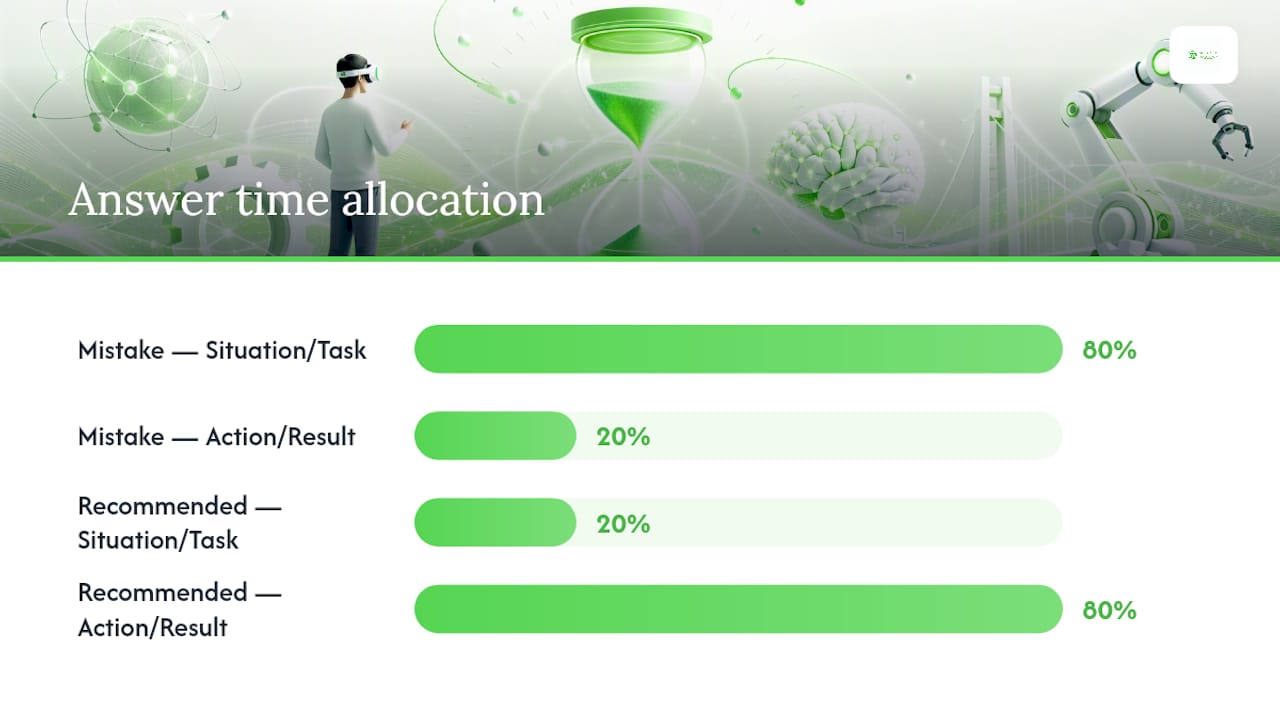
STAR stands for Situation, Task, Action, Result, and it is the default framework for behavioral interview questions at the graduate level. The most common mistake is spending 80% of your answer setting up the Situation and Task, then rushing the Action and Result in a single breathless sentence. Flip that ratio. Interviewers want to hear what you actually did and what changed because of it, not a detailed backstory.
Career offices that build behavioral frameworks for graduate interviews, including Tulane’s career engagement guide, consistently point candidates toward the same short list of high-value prompts:
Tell me about a project where you had to change your approach midway through.
Describe a time you disagreed with a teammate or advisor about a technical decision.
Walk me through a failure and what you did afterward.
Give an example of a deadline you almost missed and how you handled it.
Describe a time you had to explain a technical concept to someone without your background.
For the Result section specifically, quantify wherever you can. “Reduced cycle time by roughly 15%,” “cut test failures in half,” or “brought a prototype from concept to bench test in six weeks” all land harder than “the project went well.” Vague outcomes make interviewers do the work of guessing your impact, and they usually guess conservatively.
Pro Tip: Practice your STAR stories out loud, but never script them word for word. Memorized answers sound flat and fall apart the moment an interviewer asks a follow-up you did not anticipate. Instead, memorize the bullet points of Situation, Action, and Result, and let the exact wording change each time you tell it.
How Should You Structure Your Engineering Interview Prep?
Time-box your prep around a clear sequence: fundamentals first, then project stories, then systems-level thinking, then a scan of current trends in your subfield. Trying to do all four at once the night before an interview is how candidates freeze on basic questions they actually know.
Mock interviews matter more than solo review. Three formats work well depending on what you have access to:
Peer mocks: trade technical questions with a classmate in your specialization and time each other.
Recorded mocks: answer a prompt on video, then watch it back for filler words and pacing.
Structured mock platforms or career-center sessions: useful for behavioral polish and unfamiliar interviewer styles.
Beyond mocks, three drills build interview-specific muscle fast:
Whiteboard timing: solve a technical problem in under 8 minutes, narrating assumptions as you go.
Explain-to-a-nontechnical-listener: describe your thesis or capstone project to someone outside engineering in under 90 seconds.
Debugging aloud: talk through a broken piece of code or a flawed calculation without going silent while you think.
Where you put your limited hours depends on the role. Research-track and admissions interviews reward deep familiarity with faculty work and lab fit, covered more in the section on questions to ask. Industry internship interviews reward tighter, more quantified project stories and faster technical recall.
What Are Strong Answer Templates for Technical and Behavioral Questions?
A repeatable structure beats a clever one-off answer, because it holds up under nerves. Use these two skeletons and adapt the specifics to your field.
Technical walkthrough template: State your assumptions (“Assuming steady-state conditions and negligible friction…”) → name your method (“I’d apply conservation of energy here…”) → work the problem while narrating each step → check the result (“That checks out dimensionally, and the magnitude is reasonable for this scale”).
STAR behavioral template: One sentence of Situation (“During my capstone, our sensor array was returning noisy data”) → one sentence of Task (“I needed to isolate the source before our demo in two weeks”) → two to three sentences of Action (“I built a filtering script, cross-checked it against three known datasets, and looped in my advisor when the noise pattern didn’t match expectations”) → one sentence of Result with a number (“We cut false readings by roughly 40% and hit the demo deadline”).
Customize both templates by specialization and seniority. A PhD-track applicant should lean harder into methodology and literature awareness; a candidate targeting an industry internship should lean into speed, teamwork, and deliverables.
Watch your phrasing. Replace “I don’t really know” with “Here’s how I’d find out.” Replace “it just worked” with the specific mechanism that made it work. Replace “we struggled a lot” with what changed once you fixed the actual problem. Michigan’s technical interview guidance is direct about this: candidates who explain how they’d verify results, rather than admitting defeat outright, read as stronger problem-solvers even when they don’t land the perfect answer.
What Should You Ask the Interviewer?
The best candidates turn the last few minutes into a real conversation instead of a formality. Admissions and career experts agree this is one of the highest-leverage moves available to you, precisely because so few candidates do it well. Duke University’s technical interviewing guide recommends asking about industry partnerships, specific research projects, or the team’s current challenges rather than generic questions you could have answered by reading the website.
Ask about a specific faculty project or lab, not “what kind of research do you do.” Naming the lab shows preparation, and admissions interview guidance for master’s programs confirms interviewers favor candidates who reference exact research fit.
For internship or industry roles, ask what the team’s biggest technical bottleneck has been in the last quarter.
Ask how the program or team structures mentorship or supervision day to day.
Pick two or three questions in advance, but let the conversation dictate which ones you actually ask.
What Mistakes Do Candidates Make, and How Do You Fix Them?
No concrete metrics in Results: spend 20 minutes rewriting three past projects with a number attached to each outcome.
Weak project prep: spend 30 minutes re-reading your own thesis or capstone abstract and drafting one STAR story per major project.
Poor communication under pressure: record yourself explaining one technical concept in 90 seconds, twice.
Failing to research the program or company: Indeed’s guidance for graduate engineer interviews names this as one of the most common preparation gaps, alongside skipping practice on specialization-specific concepts and offering vague, example-free answers.
Reword red flags before they leave your mouth: swap “I didn’t have time to finish” for “I prioritized the core function and left the extension as a next step.”
What Proof Points Strengthen an Engineering Interview Answer?
Real project exposure beats theoretical knowledge in almost every interview. Candidates who have worked on live, industry-connected problems, rather than textbook exercises, tend to describe their reasoning with more confidence and specificity.
Metapilotacademy’s programs build around this idea directly, pairing students with corporations such as Boeing and NASA on practical projects rather than simulated case studies. If you have been through a demo day, a partner-sponsored project, or a selective recruitment event, that is exactly the material to slot into your STAR Action and Result sections. Naming a specific deliverable, a partner organization, or a faculty advisor turns a generic answer into a memorable one. If your own program offers similar touchpoints, alumni outcomes, or named faculty research, use those specifics the same way.
What Interview Formats Should You Expect?
Most engineering master’s interviews run through a predictable sequence, and knowing the sequence lets you match your prep to the right format instead of over-preparing for the wrong one. Graduate interview guides lay out the typical rounds: a phone or video screen, a technical assessment, a behavioral interview, sometimes a case study or presentation, and a final panel.
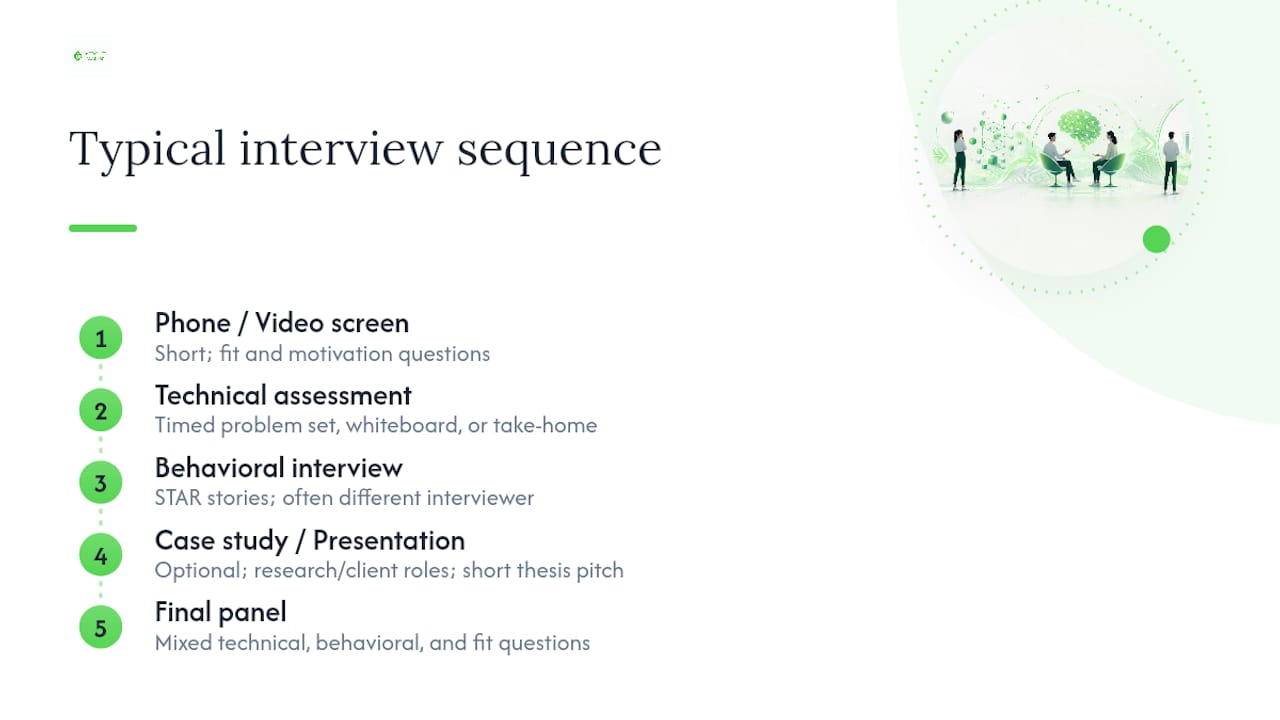
The phone screen is usually short and focused on fit and motivation. Expect “why this program” and “walk me through your background” more than deep technical probing. The technical assessment is where fundamentals get tested, often through a timed problem set, a whiteboard session, or a take-home exercise reviewed live afterward. The behavioral round is where STAR stories carry the weight, and it’s often run by a different interviewer than the technical round, sometimes someone from admissions or HR rather than faculty.
Case studies and presentations show up more often for research-track admissions and for roles requiring client-facing communication. You might be asked to present your thesis in five minutes or walk a panel through how you’d approach an open-ended design problem. The final panel round typically combines elements of all three; expect a mix of technical, behavioral, and fit-based questions from multiple interviewers at once, sometimes including a faculty member and a program administrator together.
Ask ahead of time, if you can, which rounds you’ll face. Programs and companies vary in how many rounds they run and in what order.
What Are Interviewers Actually Evaluating?
Beyond the correctness of any single answer, interviewers are watching how you think, communicate, and handle pressure. A technical answer with a wrong final number but a clean, logical process often scores better than a lucky right answer delivered with no explanation of method.
Communication clarity matters as much as content. Can you explain a complex idea to someone outside your specialization without losing precision? That skill shows up directly in research settings, where you’ll need to brief advisors and committees who don’t share your exact technical background, and in industry settings, where you’ll brief managers and clients.
Fit is the third layer, and it’s often underweighted by candidates. Interviewers are gauging whether you understand what the specific program or role actually involves, whether you’ve done homework on their projects or partnerships, and whether your stated goals align with what they can realistically offer you. A technically strong candidate who clearly hasn’t researched the program will often lose out to a slightly less polished candidate who has.
Composure under follow-up questions is the final signal. Interviewers frequently push back on your first answer, not because it was wrong, but to see how you handle being challenged. Treat a follow-up question as a chance to add nuance, not as proof you got it wrong the first time.
How Should You Follow Up After the Interview?
Send a thank-you note within 24 hours, addressed to each interviewer individually if you spoke with more than one. Keep it short: thank them for their time, reference one specific thing you discussed (a project, a research area, a piece of advice), and reaffirm your interest in the program or role.
Avoid generic templates. A note that says “I enjoyed learning more about your work on the vertiport certification project we discussed” reads entirely differently than “Thank you for the opportunity to interview.” Specificity signals that you were actually engaged, not just going through motions.
If you were told a decision timeline, respect it before following up again. A polite check-in after the stated window has passed is reasonable; repeated follow-ups before that window closes can read as impatience. If no timeline was given, a follow-up after one to two weeks is generally safe for most academic and industry processes.
Use the post-interview period productively. Write down every question you were asked while it’s fresh, and note which answers felt weak. That list becomes your next prep session, whether for this program’s next round or for a different interview entirely.
What Background Checks or Extra Assessments Should You Expect?
Many engineering master’s programs and industry roles run additional verification steps after the interview itself, and it helps to know these are standard rather than a sign something went wrong. Academic programs typically confirm transcripts, degree conferral dates, and English proficiency scores if required. Industry roles, especially in aerospace, defense, and biotech, often require background checks tied to security clearance eligibility or export control compliance, given the sensitivity of the work.
Some programs and employers add a supplementary technical assessment after the interview, particularly for research assistantships where a specific skill (a coding language, a lab technique, a modeling tool) needs direct verification beyond what a conversation can confirm. Others request writing samples, a research statement, or reference checks with previous supervisors or professors.
None of these stages should catch you off guard if you’ve been transparent throughout the interview process. The best approach is to have your transcripts, certifications, and reference contacts ready before you’re asked, so a request for documentation doesn’t stall your candidacy while you scramble to gather materials.
Where Can You Practice Further?
For deeper technical drills, university career-center pages like Duke’s interviewing quick guide offer STAR templates and quantification tips. For discipline-specific problem banks, your own department’s career office is usually the fastest route to real past-interview questions from alumni.
What Most Candidates Get Backwards About Engineering Interview Prep
Most prep advice pushes candidates toward memorizing more technical facts, when the actual gap is almost always communication under pressure. Candidates who can solve a problem alone but freeze when asked to narrate their thinking lose more interviews than candidates with slightly weaker technical range but clear, confident delivery.
The other overlooked piece is specificity. Generic project stories and generic questions to interviewers signal generic preparation, and interviewers notice immediately. A candidate who names a specific faculty lab, a specific partner project, or a specific quantified result stands out simply by being concrete in a room full of vague answers.
If you take one thing from this guide, prioritize rehearsing your project stories out loud before you touch another practice problem set. Fundamentals matter, but most master’s-level candidates already have them. What separates offers from rejections is usually the ability to talk clearly about what you actually built, broke, and fixed. Programs like Metapilotacademy’s master’s tracks that build in real industry projects give candidates something concrete to talk about; if your own program hasn’t, build that material yourself before your next interview, not the night before.
— Metapilot
Sources
FAQ
What Is the 30-60-90 Rule in an Interview?
The 30-90 rule refers to a first-90-days plan some candidates prepare for job interviews, outlining what they’d focus on in the first 30 and 90 days of a role. It’s more common in industry hiring than academic admissions interviews, but research-track candidates can adapt it into a first-semester research plan if asked how they’d approach their first months in a lab.
What Are the 5 C’s of Interviewing?
Definitions of the “5 C’s” vary by source, and no single version is universal across engineering interviews. Rather than memorizing a specific acronym, focus on the fundamentals covered above: clear communication, concrete examples, and demonstrated competence tend to matter more than fitting your answers into any five-word framework.
What Are Some Common Questions Asked During a Master’s Degree Interview?
Expect a mix of background questions (“why this program,” “walk me through your research interests”), technical fundamentals tied to your field, and behavioral prompts about past projects or setbacks. Master’s admission interviews specifically favor candidates who can reference specific faculty research or lab fit rather than generic interest in the field.
What Is the Best Answer for “What Are Your Three Weaknesses?”
The strongest structure names a real, specific weakness, then immediately pivots to the concrete action you took to address it. For example: “I used to underestimate how long debugging would take, so I started building buffer time into every project timeline after a capstone deadline taught me that lesson.” Avoid fake weaknesses disguised as strengths (“I’m too much of a perfectionist”) since interviewers hear that phrasing constantly and it reads as unprepared rather than self-aware.
Recommended
Comments