
Get Job Ready in 12–24 Months: Robotics, AI, or Metapilot Neurotech

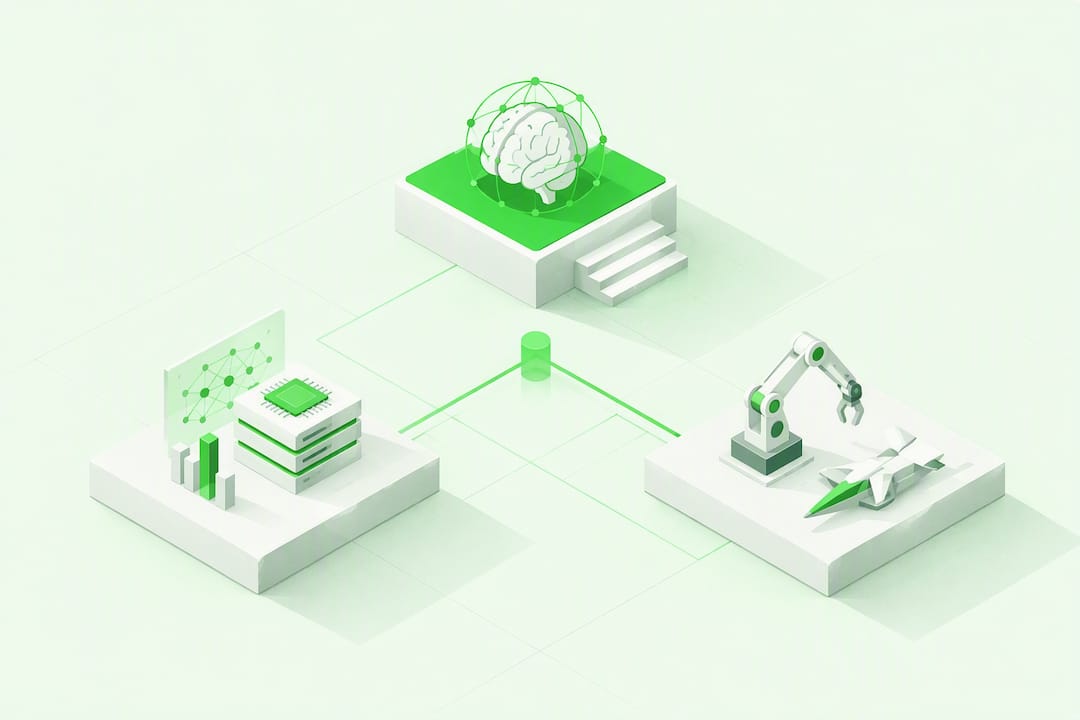
Choose an AI degree if you want to build software, models, and data systems; choose robotics if you want to design and control physical machines. If your goal is autonomous systems, healthcare devices, or anything where a machine has to sense and act in the real world, you will eventually need both skill sets, and the strength of the program’s labs matters more than the label on the diploma.
TL;DR:
A robotics program is more hardware-intensive, requiring significant hands-on experience with real robots and control systems, while AI focuses on data, models, and software development.
Demand for AI specialists continues to grow faster globally, but robotics careers are more region-specific, especially where manufacturing automation is expanding.
Verify program quality by assessing actual lab hours, hardware access, capstone ownership, and employer partnerships, rather than relying on marketing claims or salary averages.
Online AI degrees tend to be faster and cheaper, but in-person robotics programs offer better practical training, especially with physical testing and calibration.
Combining AI and robotics skills typically involves targeted electives or microcredentials, with programs like Metapilot’s neurotechnology master’s integrating both fields alongside industry connections.
Table of Contents
Robotics vs AI Degree: What Each Path Actually Trains You For
An AI degree trains the “brain.” A robotics degree builds the “body” and teaches you to control it. That distinction between AI and robotics sounds simple, but it shapes everything from your daily coursework to your first job title.
AI programs treat intelligence as software: you write algorithms, train models on data, and ship them into applications. Robotics programs treat intelligence as embodied: you still write code, but it has to move a motor, read a sensor, or balance a chassis in real time, where AI simulates human intelligence in software while robotics designs and builds the physical machines that intelligence controls.
Here’s how the two paths tend to diverge on paper:
AI graduates often land roles like machine learning engineer, data scientist, NLP engineer, or computer vision engineer, building recommendation systems, fraud detection, or diagnostic imaging tools.
Robotics graduates often land roles like automation engineer, mechatronics engineer, controls engineer, or robotics systems integrator, working on manufacturing cells, surgical robots, or autonomous vehicles.
The overlap zone is perception, planning, and autonomy stacks, where a self-driving car or a warehouse robot needs both a trained model and a working chassis to do anything useful.
If you like data more than hardware, lean AI. If you like the idea of a machine you built actually moving, lean robotics.
Curriculum and Skills You Will Learn in Each Degree
The module list tells you more than the degree title ever will. AI programs typically build around programming fundamentals, statistics, linear algebra, machine learning theory, model deployment, and data pipeline engineering, with Python and frameworks like TensorFlow or PyTorch as the working language. Research found AI curricula lean heavily on data and ML skills, and that online AI programs have grown faster than online robotics programs for a simple reason: software doesn’t need a lab bench.
Robotics curricula run in a different direction: mechanics, electronics, sensors, actuators, control theory, embedded systems, simulation environments, and actual hardware labs, usually taught in C/C++ and MATLAB alongside Python. Expect coursework in kinematics and dynamics that an AI program never touches.
Before you commit to either program, ask for specifics:
How many lab hours per semester are hands-on with real hardware versus simulation only?
Do you own your capstone project end to end, or work on a slice of a faculty project?
What manipulators, mobile platforms, or test rigs will you actually touch?
Pro Tip: Ask for the exact ratio of simulation time to hardware time in the syllabus. A robotics program heavy on simulation and light on physical testing is closer to a software degree wearing a robotics label.
Careers, Demand, and Salary Signals
Software developers had a median pay of $131,450 in 2024 with 15% projected employment growth through 2034, while mechanical engineers, the closest BLS category to robotics work, had a 2024 median of $102,320 with 9% projected growth, according to the Bureau of Labor Statistics.
By the numbers: Software roles show faster projected growth and higher median pay than mechanical engineering roles, but the comparison flattens once you factor in seniority, specialization, and location. A robotics controls engineer at an aerospace prime can out-earn a junior ML engineer at a startup with no revenue.
The World Economic Forum’s Future of Jobs 2025 report found that 86% of employers expect AI and information processing to transform their business by 2030, with AI and machine learning specialists among the fastest-growing roles worldwide. Robotics demand tells a more regional story: 74% of new industrial robot installations happened in Asia in 2024, according to the International Federation of Robotics, which means a robotics degree’s payoff depends heavily on where employers are actually deploying automation. Check local manufacturing and logistics investment before assuming a robotics degree guarantees work nearby.
How to Choose Between Programs: An Evidence Checklist
Don’t evaluate a program by its brochure. Evaluate it by what you can verify.
Confirm accreditation and whether the credential is recognized by employers in the country where you plan to work.
Pull the actual module list, not the marketing summary, and check it against the curriculum items above.
Ask about lab access: how many hours per week, what equipment, and whether it’s shared with dozens of other students.
Find out who owns the capstone project, you or the lab’s principal investigator.
Request internship and placement statistics, ideally with named employer partners, not just “industry connections.”
Ask for graduate outcomes by country, since a program’s average salary figure means little if most graduates stayed in a lower-paying market.
Get scholarship and funding terms in writing before you assume a discount applies to you.
Admissions prerequisites diverge by field: robotics programs typically expect calculus and physics, while AI programs weight linear algebra, probability, and coding experience more heavily, per Research.com’s analysis. If your math is rusty, budget three to six months of prep before applying to either.
Pro Tip: When a robotics program claims “hands-on hardware,” ask directly how many hours per month students spend testing on physical robots versus running the same project in simulation. Vague answers are a red flag.
Online vs In-Person: Format Tradeoffs and Timelines
Most AI and robotics master’s programs run 12 to 24 months. AI programs scale online more easily because the “lab” is a laptop with cloud compute. Robotics programs are bound by physical equipment, so in-person access matters more for anything beyond simulation work.
Online AI programs can move faster and cost less, but you need to independently verify project rigor since there’s no lab supervisor watching your work.
In-person robotics programs cost more time and often more money, but they give you calibration, wiring, and failure debugging that simulation cannot replicate.
Hybrid formats are becoming more common, letting students do coursework online and travel for intensive lab blocks.
If you choose an online AI track, confirm whether remote lab arrangements or local internship placements exist to round out your practical experience.
Combining AI and Robotics Without Doing Two Full Degrees
You don’t need two master’s degrees to build both skill sets. A few practical routes work well:
A double degree or major plus minor in AI and mechanical or electrical engineering, if your school offers it.
Targeted microcredentials stacked onto a core degree, letting you add ML deployment skills to a robotics base or vice versa.
Industry capstone projects that require system integration, since these force you to document real metrics: latency, uptime, sensor accuracy, and deployment notes.
A CS or AI master’s with robotics electives is often the better call if you want a software-first career with occasional hardware exposure, rather than committing to a full robotics program you may never fully use.
Build a portfolio that shows reproducible hardware tests, not just polished demo videos, to help you navigate your cyber security career path and transferable skills effectively.
The Program That Combines Neuroscience Labs With Industry Access
Neurotechnology sits at the sharpest edge of this AI-versus-robotics question, because it demands both: real neurophysiology and real engineering, with none of the pseudoscience that plagues too much of the field. Metapilotacademy’s Master in Neurotechnology was built around that requirement, pairing top neurophysiology labs with neurotech companies, recruiters, and investors rather than treating lab work and career access as separate problems.
Applicants should expect what any rigorous combined program should offer: real lab hours, industry co-designed projects, demo days where investors and employers are actually in the room, and a direct line to recruitment rather than a vague promise of “industry connections.” Faculty credentials, graduate outcomes, and accreditation details are listed on the program page for anyone comparing it against alternatives.
Editorial Take: What This Comparison Actually Tells You
The conventional advice, “pick AI for growth, pick robotics for hardware,” is true but incomplete. It ignores the variable that determines whether either degree pays off: whether the program gives you real access, real labs, real employer partners, or just a syllabus that sounds impressive on a brochure.
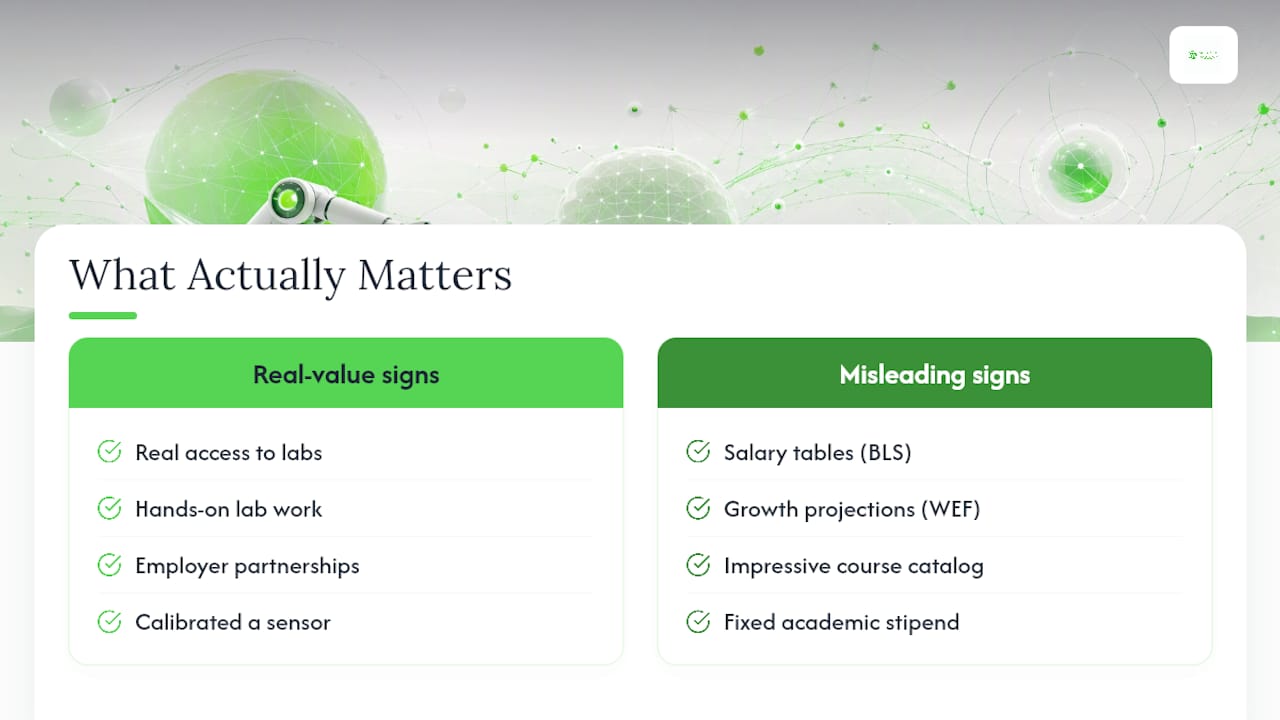
Salary tables from the BLS and growth projections from the WEF are useful for sanity checks, not decisions. A software developer’s median pay and a mechanical engineer’s projected growth rate tell you nothing about the specific program you’re evaluating. What matters is whether you’ll graduate having actually calibrated a sensor, deployed a model into production, or presented to someone with hiring authority.
If you’re a neuroscientist with real ambition, the standard path, running experiments for a principal investigator on a fixed academic stipend, was never designed to reward you for that ambition. The programs worth your time and tuition are the ones that put you in front of the people who fund and hire, not just the ones with the most convincing course catalog.
— Metapilot
Consider Metapilot Academy: How to Take the Next Step
Metapilotacademy’s Master in Neurotechnology is the direct answer for anyone stuck choosing between a pure AI degree and a pure robotics or lab-science path: it puts neurophysiology labs, AI training, and industry access into one program instead of forcing you to bolt them together yourself.
[
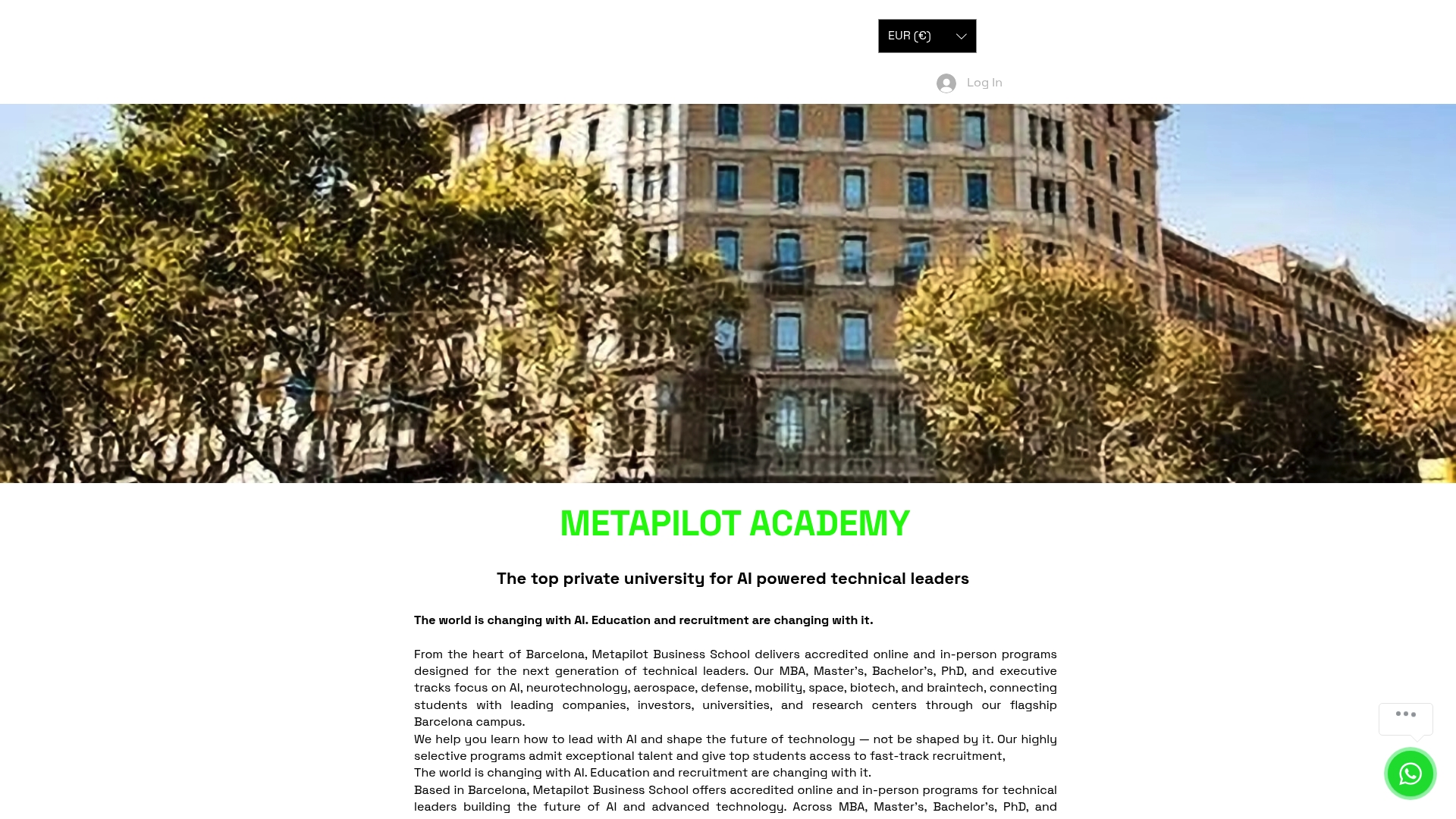
The program is run in Barcelona in person, built around a network that includes access to a pool of 50,000 tech leaders, roughly 100 neurotech labs, and around 20 neurotech companies and investors woven into the program itself, according to Metapilotacademy’s own program description. Admission is selective by design, and scholarship and funding options exist for students who qualify. Before you apply anywhere, request the actual module list, ask how many lab hours are hands-on versus simulated, and confirm who owns your capstone project. You can review the Master in Neurotechnology program details, compare it against Metapilotacademy’s full program list, or check current pricing and plans before booking an admissions call.
Sources
FAQ
Is Robotics Better Than AI?
Neither field is inherently better; robotics fits students who want to build and control physical machines, while AI fits students who want to build software and models. The right choice depends on whether you’d rather debug a motor controller or tune a model, and many careers now blend both skill sets.
Which Jobs Are Most Likely to Survive Automation?
Roles requiring hands-on physical work, complex human judgment, or direct interpersonal trust, like skilled trades, senior clinical care, and creative leadership, tend to be harder to automate than routine data-processing jobs. The WEF’s Future of Jobs 2025 report notes that AI is expected to transform, not eliminate, most roles by 2030, shifting tasks rather than removing them outright.
Who Earns More: an AI Engineer or a Robotics Engineer?
Pay depends more on seniority, industry, and location than on the degree itself. BLS data puts 2024 median pay for software developers at $131,450 versus $102,320 for mechanical engineers, but a senior robotics controls engineer at an aerospace firm can easily out-earn a junior AI hire.
Is a Robotics Degree Worth It?
A robotics degree is worth it when the program gives you substantial hands-on hardware access, real capstone ownership, and employer partnerships, not just theory and simulation. Without those elements, a rigorous AI or computer science degree paired with robotics electives can deliver comparable career value with fewer resource constraints.
How Is the Master in Neurotechnology Different From a Standard AI or Robotics Degree?
It combines neurophysiology lab work with AI training and direct industry access instead of treating them as separate tracks. The in-person Barcelona program connects students to a network including neurotech labs, companies, and investors, aiming to avoid the academic dead end of running experiments for someone else’s research at minimal pay.
Recommended
Comments