
Save Months of Bench Time: Biotech Machine Learning for Researchers


Machine learning accelerates discovery, enables protein design, and optimizes manufacturing in biotechnology, but only when paired with clean data and wet-lab validation. The three buckets that matter most are drug discovery, protein and sequence engineering, and bioprocess optimization. The caveat every researcher needs to hear first: a model is only as credible as the data pipeline and experimental confirmation behind it.
TL;DR:
Reliable biotech machine learning requires high-quality, reproducible data pipelines and rigorous validation to ensure real-world applicability.
Foundation models like LucaOne and scGPT leverage extensive pretraining to improve performance across biological tasks, but they still depend on wet-lab validation.
Proper data splitting that reflects deployment conditions is crucial to prevent overestimating model accuracy and to maintain credibility.
Regulatory approval hinges on demonstrating a clear context of use and providing proportional evidence, not just achieving high benchmark scores.
Classical machine learning methods remain relevant for small, interpretable datasets, and choosing models aligned with problem types saves time and resources.
Table of Contents
What Biotech Machine Learning Actually Delivers
Biotech machine learning refers to the use of statistical and neural models, trained on molecular, cellular, and process data, to predict biological behavior and generate new candidates faster than traditional screening allows. The field runs on three connected engines: discovery (finding or designing a molecule), engineering (optimizing a sequence or protein for function), and manufacturing (keeping a bioprocess stable and productive at scale).
None of these engines work in isolation from lab science. A 2025 review in PMC documents how AI-enabled workflows across small-molecule design, protein binder discovery, antibody engineering, and nanoparticle delivery consistently rely on a closed loop: model proposes candidates, the wet lab tests them, and the results retrain the model. That loop, not the algorithm alone, is what turns a promising prediction into a validated result.
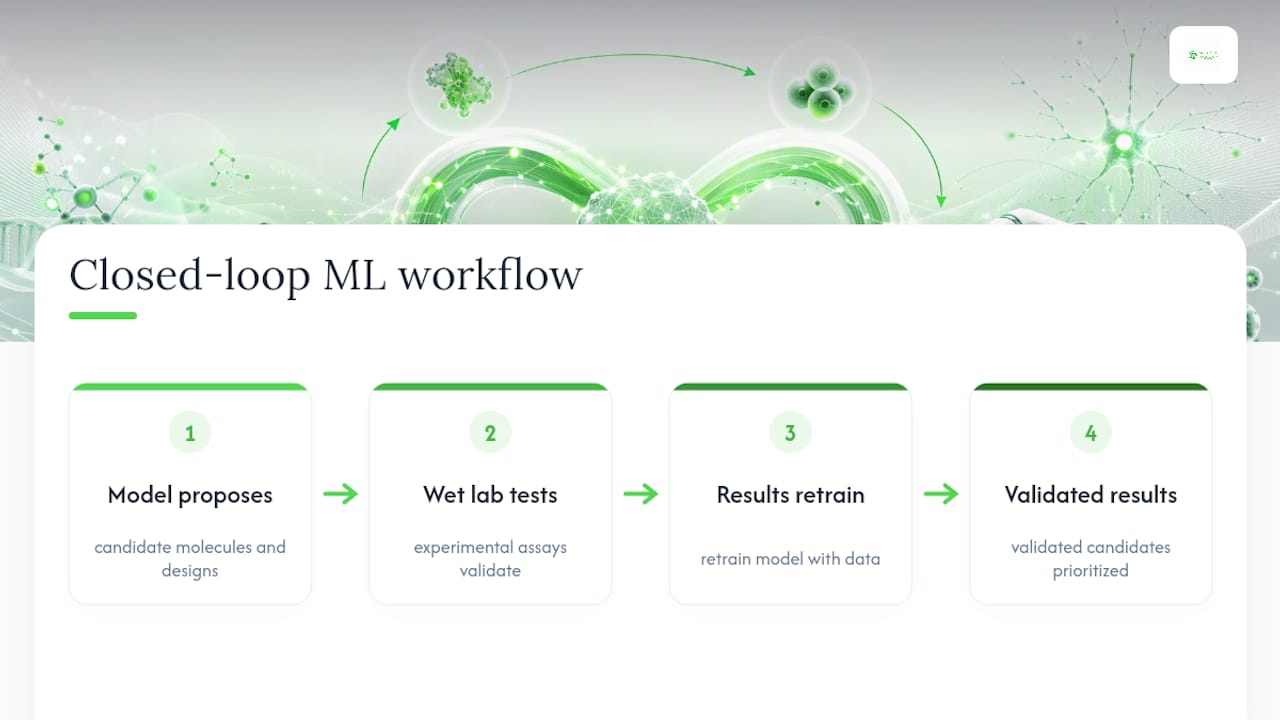
You will also hear the terms “machine learning in biotechnology,” “biotechnology artificial intelligence,” and “AI for life sciences” used almost interchangeably in the literature. They describe the same underlying discipline: applying computational pattern recognition to biological data so researchers can prioritize experiments instead of running them blind.
Why researchers should care about the caveat, not just the promise
The excitement around biotech machine learning tends to outrun the readiness of the data feeding it. Predictive models trained on small, noisy, or unrepresentative datasets can look accurate in a paper and fail in the lab. That is not a reason to distrust the field. It is a reason to build every project around reproducibility and external validation from day one, a theme that runs through every section below.
Primary Applications of Machine Learning in Biotechnology
Drug discovery is where biotech machine learning shows up most visibly. Virtual screening models rank millions of compounds against a target before a single one touches a plate, and generative design tools now propose novel molecular structures rather than just filtering existing libraries. ADMET prediction, absorption, distribution, metabolism, excretion, and toxicity, has become a standard early filter, catching likely failures before they consume months of bench time.
Protein structure prediction changed the discovery timeline more than almost any other advance. AlphaFold turned structure-based design from a slow, crystallography-dependent process into something researchers can iterate on computationally within days. That shift accelerated binder identification, antibody engineering, and rational mutagenesis across the field, because teams no longer need a solved crystal structure before they can reason about a binding site.
Biomarker discovery increasingly depends on multi-omics integration, combining genomic, transcriptomic, and proteomic signals to identify disease subtypes or predict treatment response. Machine learning models trained across these layers can flag candidate biomarkers that no single omics layer would surface on its own, though the models are only as good as the alignment between datasets.
Synthetic biology has its own applications: sequence design tools optimize promoters, codon usage, or regulatory elements for a target organism, while separate models optimize nanoparticle formulations for drug delivery. These two areas rarely get equal attention next to drug discovery headlines, but the design principles are similar. You are searching a combinatorial space too large to test exhaustively and using a model to narrow it.
The measurable outcomes are becoming harder to ignore. The PMC review referenced above reports concrete improvements in hit validation rates and engineering outcomes across the studies it surveys, driven largely by that same predict-test-retrain cycle rather than any single model architecture.
Here is how the four application areas break down in practice:
Drug discovery: virtual screening, generative molecule design, and ADMET prediction to cut early-stage attrition.
Protein structure and design: AlphaFold-class structure prediction feeding binder, antibody, and enzyme engineering pipelines.
Biomarker discovery: multi-omics models for patient stratification and novel target identification.
Synthetic biology and delivery: sequence and regulatory-element design paired with nanoparticle and formulation optimization.
Each of these areas depends on a different flavor of model, which is exactly where method choice starts to matter.
Machine Learning Methods and Model Classes Used in Biotech
Picking the right model family is not a stylistic choice. It determines whether your project can even answer the question you are asking. Sequence-based problems, structure-based problems, and design problems call for genuinely different tools.
Transformers and sequence foundation models dominate nucleic-acid and protein-sequence tasks. These models treat DNA, RNA, or amino acid sequences the way large language models treat text, learning statistical patterns across enormous corpora of sequences and then fine-tuning on a specific downstream task like function prediction or variant effect scoring.
Geometric deep learning handles problems where three-dimensional structure carries the signal. Predicting how two proteins dock, or how a small molecule fits into a binding pocket, requires architectures that respect spatial relationships rather than treating the input as a flat sequence. This is the model family behind most structure-and-interaction prediction work that follows AlphaFold-style structure generation.
Generative models, diffusion models, variational autoencoders, and generative adversarial networks, are the engines behind de novo molecule and sequence design. Instead of scoring existing candidates, they sample new ones directly from a learned distribution of “plausible and useful” structures, which is how generative design tools produce molecules that were never in the training library.
Reinforcement learning and active learning solve a different problem: how do you search a fitness landscape efficiently when every experimental test is expensive? The μProtein framework is a clean example. Researchers combined a mutational-effect predictor with reinforcement learning to search multi-mutation fitness landscapes and identify high-gain β-lactamase mutants, training the system using only single-mutation data. That is a meaningful result: the model generalized to combinations it had never directly observed, cutting the number of wet-lab rounds needed to find strong variants.
None of this replaces classical machine learning baselines, and dismissing them is a mistake newer researchers often make. Random forests, gradient-boosted trees, and simple regression models remain the right first step for tabular biological data, smaller datasets, or any project where interpretability matters more than marginal accuracy gains. A deep model that beats a well-tuned baseline by a fraction of a percentage point rarely justifies its added complexity and reduced transparency.
A quick map of method to problem type:
Sequence classification or generation: transformer-based language models.
Structure and interaction prediction: geometric deep learning.
De novo design: diffusion models, VAEs, or GANs.
Efficient experimental search: reinforcement learning paired with active learning loops.
Small or tabular datasets: classical ML baselines first, always.
Choosing correctly here saves months. Choosing a fashionable architecture for a problem it was not built to solve is one of the most common and expensive mistakes in applied biotech ML.
Data, Pipelines, and Project Workflow for Reliable Results
A model’s credibility gets decided before training even starts. Everything downstream, evaluation, regulatory conversations, wet-lab buy-in, traces back to how the data was collected, labeled, and split.
Metadata standards and annotation quality come first. Platforms built for AI-ready R&D data, such as Genedata’s approach to structured, traceable datasets, emphasize that raw data provenance and consistent ontology mapping have to exist before a model can be trusted, let alone published.
Leakage-resistant splitting is the step most commonly skipped, and it is the one that inflates performance the most. Randomly splitting near-duplicate molecules, cells from the same patient, or repeated measurements across train and test sets creates leakage that makes a model look far more accurate than it is. The fix is to split by study, by time, by patient, or by chemical scaffold, whichever boundary matches how the model will actually be deployed.
Here is a practical sequence for building a project that survives scrutiny:
Define the context of use before writing any code. What decision will this model support, and how wrong can it afford to be?
Establish a classical baseline so any deep learning gain is measured against something honest.
Design leakage-resistant splits aligned to the deployment scenario, not to convenience.
Preserve full reproducibility artifacts, raw data, seeds, checkpoints, preprocessing versions, and assay protocols, exactly as Genedata’s infrastructure guidance recommends.
Evaluate beyond AUROC: check calibration, top-k precision at experimentally feasible throughput, and uncertainty estimates.
Run prospective wet-lab validation on a held-out batch of real candidates, not just a historical test set.
Monitor after deployment, since biological distributions drift as new strains, patient populations, or reagent lots enter the pipeline.
Pro Tip: A high AUROC score means very little on its own. Ask instead how many of your model’s top 20 predictions would actually be worth ordering in the lab, and whether the model tells you when it is uncertain. That single question separates a publishable model from a usable one.
Governance does not end at deployment. Continuous validation, revisiting performance as new data arrives, is what keeps a model from quietly drifting away from the biology it was trained to reflect.
Foundation Models and Recent Case Studies
Foundation models in biotech work the same way large language models do in text: pretrain on a broad, diverse corpus, then fine-tune for a narrow downstream task. The biological version pretrains on nucleic-acid sequences, protein sequences, or single-cell expression profiles instead of sentences, and the payoff is a model that already understands broad biological patterns before it ever sees your specific problem.
LucaOne is one of the clearest recent examples. It is a unified nucleic-acid and protein foundation model trained on sequences from many species, and it shows improved performance across several downstream biological tasks compared with models trained on a single data type. The unification matters: DNA, RNA, and protein sequences are usually modeled separately, and LucaOne’s cross-modal training lets it capture relationships between them that narrower models miss entirely.
scGPT takes the same foundation-model logic into single-cell biology. A 2025 Nature perspective on multimodal pretraining across omics describes how scGPT uses single-cell datasets to support cell-type recognition, biomarker discovery, and in-silico perturbation experiments, essentially letting researchers simulate the effect of a genetic or chemical perturbation before running it in a dish.
The μProtein case study, already introduced above, deserves a second look here because it illustrates what a foundation-adjacent approach looks like in protein engineering specifically. Its mutational-effect predictor learned from single-mutation data, and the reinforcement learning search layer extrapolated to multi-mutation combinations, landing on high-gain β-lactamase variants that a brute-force combinatorial search would have taken far longer to find.
What these three case studies share:
Broad pretraining data reduces the amount of task-specific labeled data needed downstream.
Cross-modal or multi-mutation generalization is the recurring payoff, models transfer knowledge beyond their direct training examples.
Compute and data requirements remain steep. Training a foundation model from scratch is out of reach for most academic labs; fine-tuning an existing one is the realistic path.
Bias and transferability caveats persist. A model trained predominantly on well-studied organisms or cell types will underperform on understudied ones, and that gap rarely shows up until you test it directly.
Foundation models are not a shortcut around wet-lab validation. They are a better starting point for the predict-test-retrain loop that runs through every credible result in this field.
Bioprocessing, Manufacturing, and Digital Twins
Manufacturing is where biotech machine learning earns its keep in dollars, not just publications. Soft sensors estimate hard-to-measure process variables, like metabolite concentration, in real time from easier-to-collect signals. Feeding optimization models adjust nutrient delivery schedules dynamically instead of following a fixed recipe. Chromatography scouting models predict optimal purification conditions without running every combination physically, and predictive maintenance models flag equipment issues before they cause a batch failure.

Process analytical technology, PAT, ties these pieces together by feeding real-time sensor data into models that adjust the process as it runs rather than waiting for end-of-batch quality checks. The industrial upside shows up as measurable gains: fewer scouting experiments needed to find workable chromatography conditions, and process teams reporting stronger titer outcomes when hybrid models replace purely empirical tuning.
Hybrid mechanistic and data-driven models are the practical middle ground most manufacturing teams land on. A pure mechanistic model, built from known biochemical kinetics, is interpretable but often too rigid to capture real-world process variation. A pure data-driven model captures that variation but can behave unpredictably outside its training range. Combining both, using mechanistic structure with a data-driven correction layer, tends to outperform either approach alone, which is the logic behind most digital-twin setups now running in bioprocess development.
The constraints are unglamorous but real:
Sensor quality limits everything downstream; a noisy soft sensor produces a noisy model no matter how good the algorithm is.
Legacy equipment often lacks the instrumentation needed for real-time data capture, forcing costly retrofits.
Data harmonization across batches, sites, and equipment vendors remains one of the most time-consuming parts of any manufacturing ML project.
Regulatory Credibility and Evidence Expectations
Regulatory credibility starts with a question most researchers skip: what decision is this model actually informing? FDA’s draft framework makes context of use the organizing principle for evaluating AI models used to support drug and biological product submissions. The same model architecture can be treated very differently depending on whether it informs an early exploratory hypothesis or a final regulatory decision, since credibility must be defined against that specific context, not against the model in the abstract.
The FDA’s draft guidance calls for a risk-based credibility assessment: teams document a credibility plan, define acceptance criteria before seeing results, and provide validation evidence proportional to how much a decision relies on the model’s output. A model used to prioritize which of 500 compounds to synthesize next carries a very different evidence burden than one used to support a safety claim in a submission.
Practical steps that make this manageable instead of paralyzing:
Engage regulators early, before the model architecture is locked in, so the evidence plan matches expectations rather than retrofitting one after the fact.
Build traceable pipelines from the start, since a credibility review will ask for the same reproducibility artifacts, seeds, versions, checkpoints, discussed in the workflow section above.
Pursue external validation, ideally from a lab or dataset independent of the one that generated the training data, because internal validation alone rarely satisfies a risk-based review.
Match model design to the evidence bar, choosing simpler, more interpretable architectures when the context of use demands transparency over marginal accuracy.
The framework’s biggest practical effect is upstream of any submission. It pushes teams to decide, at project kickoff, how much evidence a given use case will realistically require, rather than building the fanciest model first and discovering the evidence gap later.
Tools, Platforms, and Getting Started
A reproducible biotech ML project needs four infrastructure pieces before it needs a fancy model: data versioning, experiment tracking, compute with containerization, and a clear interface between the model and lab automation systems. Skipping any one of these is usually why a promising internal model never survives contact with a second dataset.
Open-source model libraries and public datasets are the fastest way to get oriented. Structure-prediction tools built on AlphaFold’s approach, single-cell foundation models like scGPT, and unified sequence models like LucaOne all have published architectures and, in most cases, accessible weights or APIs worth exploring before building anything from scratch.
Define the context of use in one sentence before writing code.
Build a classical baseline first, always.
Write out the splitting plan and defend it against leakage.
Set an external validation plan before training, not after.
Estimate compute costs upfront; fine-tuning a foundation model is far cheaper than training one.
Decision factor | In-house infrastructure | Cloud or managed platform |
Data sensitivity | Preferred for patient or proprietary datasets | Requires strong contractual safeguards |
Team size | Needs dedicated MLOps support | Lower maintenance burden |
Compute needs | Cost-effective at sustained high usage | Better for bursty, project-based workloads |
Time to first result | Slower setup | Faster initial deployment |
Metapilot’s Perspective on Training the Next Generation
Building credible biotech machine learning takes more than a strong model. It takes researchers fluent in both experimental design and computational rigor, people who can define a context of use, defend a splitting strategy, and know when a result needs another round in the wet lab before anyone trusts it.
That cross-disciplinary fluency is exactly what leading technical education programs build into their curricula. Through tracks like AI Agents for Biotech, Medtech and Neurotechnology, students work through real-world problem-solving projects developed alongside industry partners, the same kind of applied exposure that produces researchers comfortable moving between a Jupyter notebook and a bioreactor readout.
Metapilotacademy’s strength comes from its industry connections, including collaborations highlighted in initiatives like Neurobotx’s partnership with Metapilot, which give students direct exposure to how biotech and neurotechnology companies actually deploy machine learning. For readers who want structured training rather than piecing this knowledge together from papers alone, the full program catalog is worth a look.
An Honest Take on Where This Field Is Headed
The evidence in this guide points to one uncomfortable truth: the algorithm is rarely the bottleneck. LucaOne and scGPT prove that broad pretraining transfers well across biological tasks, and μProtein proves that active learning can shrink the experimental search space dramatically. What consistently determines whether any of that translates into a usable result is the unglamorous stuff, leakage-free splits, honest baselines, and a genuine wet-lab feedback loop.
Conventional advice in this space overindexes on model architecture and underindexes on the FDA’s core insight: credibility is defined by context of use, not by benchmark scores. A researcher who masters reproducible data practices and knows how to frame a credibility argument will outperform one chasing the newest architecture with sloppy data.
If you take one thing from this guide, prioritize the data pipeline and the validation plan before the model choice. Everything else follows from that.
— Metapilot
This article is general information, not a substitute for advice from a qualified doctor. Consult a qualified healthcare professional about your own circumstances before acting on anything here.
Sources
For readers who want to go deeper than this guide allows, a handful of sources anchor most of the claims above. The Nature perspective on multimodal foundation models lays out the case for cross-omics pretraining and is the clearest entry point for understanding where scGPT fits in the broader landscape. The PMC review of AI applications in drug discovery is the most comprehensive single survey of validated outcomes across small-molecule, binder, antibody, and delivery work.
For the protein engineering side, the μProtein paper and the LucaOne paper are both worth reading in full rather than summary. And for anyone building a model that might eventually touch a regulatory submission, the FDA’s draft credibility framework is required reading well before the model is finished, not after.
FAQ
What Is Biotech Machine Learning Used For?
Biotech machine learning is used for drug discovery, protein and sequence design, biomarker identification, and bioprocess optimization. The common thread across these uses is a predict-then-validate cycle, where a model proposes candidates and wet-lab results confirm or retrain it.
How Does AlphaFold Fit Into Biotech Machine Learning?
AlphaFold predicts protein three-dimensional structure from sequence data, replacing much of the slow, crystallography-dependent process researchers previously relied on. Its structure predictions now feed directly into binder discovery, antibody engineering, and rational protein design pipelines.
What Are LucaOne and scGPT?
LucaOne is a unified nucleic-acid and protein foundation model trained on sequences from many species, showing improved performance on several downstream biological tasks. scGPT is a single-cell foundation model used for cell-type recognition, biomarker discovery, and in-silico perturbation experiments.
Why Does Data Splitting Matter So Much in Biotech ML?
Randomly splitting near-duplicate molecules or cells from the same patient across train and test sets creates leakage that inflates a model’s apparent accuracy. Biologically meaningful splits, by study, time, patient, or chemical scaffold, give a far more honest picture of how a model will perform on genuinely new data.
What Does the FDA’s Draft AI Framework Require?
The FDA’s draft framework requires a risk-based credibility assessment tied to a model’s specific context of use, including a documented credibility plan and predefined acceptance criteria. The evidence burden scales with how much a regulatory decision relies on the model’s output, not a fixed universal standard.
Can Classical Machine Learning Still Compete With Deep Learning in Biotech?
Yes, classical models like random forests and gradient-boosted trees remain the right choice for smaller or tabular datasets and for projects where interpretability matters more than marginal accuracy. A deep learning model that barely outperforms a tuned baseline rarely justifies its added complexity.
Recommended
Comments