
Online vs On-Campus Master's: How to Choose in 2026


The best format is the one that matches how you learn, what you already earn and what the degree has to prove. If you work in AI or advanced technology, the strongest answer is often a program that blends flexible delivery with real projects and industry contact. That is how we build our Master in applied Artificial Intelligence and Master in Neurotechnology, with online and in-person formats so you can study around your career instead of pausing it.
This guide explains the real differences, with evidence, and ends with a simple way to decide.
TL;DR
Online suits working professionals who need to keep earning; on-campus suits learners who want structure, labs and daily contact with peers.
Employers tend to care more about accreditation, skills and reputation than about delivery format.
Tuition is not always lower online, so compare the full cost, including relocation, travel and lost income.
Full-time is faster; part-time spreads the workload and lets you keep your job.
Judge any technical program by its projects, industry partners and recruiting pathways, not only by format.
Table of Contents
What actually differs between online and on-campus
The biggest difference is how instruction reaches you. On campus, you attend scheduled classes in person. Online, you watch lectures, join live sessions and submit work through a learning platform. Some programs are “hybrid” (a mix of both) or “multimodal” (several delivery options in one program).
The academic bar does not change. ETS notes that coursework is equally challenging across formats. What changes is the support around it: remote study demands more self-discipline, while campus attendance gives a more structured, accountable setting.
The trend is toward the middle. GMAC’s 2024 report, drawing on 4,105 candidates in 132 countries, found preference for hybrid learning growing at the expense of in-person learning, while interest in fully online study stayed flat. AACSB’s 2024 enrollment report found 70% of master’s specialist students still choose face-to-face, with a noticeable rise in hybrid and multimodal formats.
Flexibility, interaction and practical learning
Flexibility is the headline benefit of online study. Sanjeev Khagram, dean of Thunderbird School of Global Management, told GMAC that most master’s students are working professionals, so leaving a career for a year or two is a huge tradeoff. Studying alongside full-time work removes it.
Flexibility has a catch: you manage your own time. A 2025 University of Auckland thesis describes it as a double-edged sword, because autonomy helps those who plan well and strains those who do not. The same study found that online success depends heavily on course design and active interaction. On-campus learning was most preferred overall for structure and community, and blended learning came second, with about 35% of participants choosing it as their ideal.
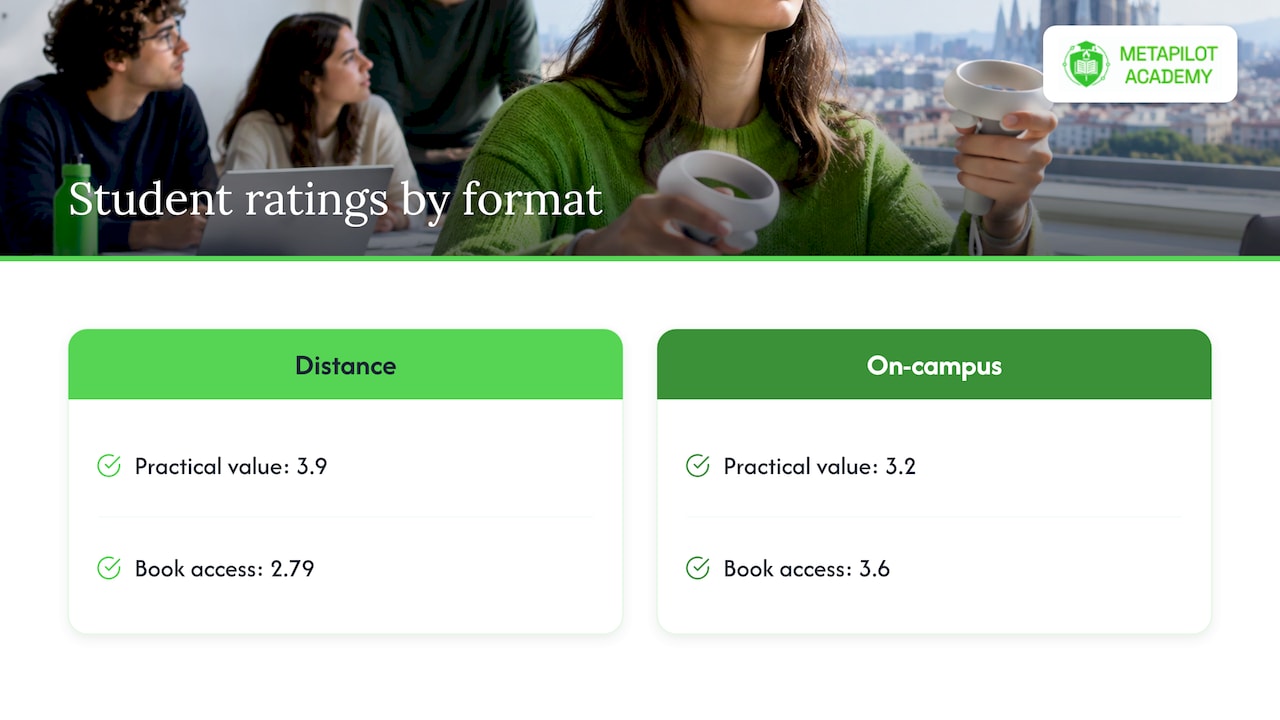
Practical value can favor online too. In a UK study of one MA program, distance students rated the course more practical (3.9 vs 3.2) because they could apply theory immediately in their own classrooms. The on-campus group rated access to books higher (3.6 vs 2.79). If your job is the lab, online study turns your workday into course material.
On community, Leila Guerra of Imperial College London told GMAC that online students can have the same networking, collaboration, pastoral care (personal support) and faculty access, in a design that goes well beyond watching recorded videos. Good teaching design matters; for a deeper look at how adults retain what they learn, see these adult learning principles that stick.
Labs, hardware and hands-on technical work
Technical fields add one more question: do you need physical equipment? ETS points out that STEM and health-care master’s programs may require laboratory work or research, which can make campus study more convenient for those requirements, and that rules vary by program.
For AI, software-heavy work and AI agents (software that takes actions toward a goal on its own), cloud tools mean you can build real systems from anywhere. For neurotechnology (technology that reads or influences the nervous system) or aerospace hardware, ask where the practical work happens and how a program delivers it. Our programs are built around practical, industry-led projects co-designed with corporations such as Boeing and NASA, and we offer both online and in-person formats, so you can choose the mix your project work needs.
Will employers respect an online master’s?
This is the question behind most searches, and the evidence is reassuring. College Transitions summarizes employer research suggesting that when a degree comes from an accredited institution, fits the job and comes with relevant experience, most hiring managers do not distinguish online from on-campus credentials. It cites a Northeastern University/Gallup survey in which only 28% of business leaders said where a candidate attended college is very important, versus 84% citing job-relevant knowledge and skills.
Two cautions keep you honest. GMAC found that two-thirds of employers believe in-person programs impart stronger technical skills, although U.S. and technology-sector employers were the most open to online. And GMAC concludes that employer perceptions have not kept pace with how much online programs have changed. The practical answer is to make your skills visible: projects, a portfolio and employer-connected work.
Before you commit, check three things:
Accreditation. Confirm the institution is recognized by the relevant education authority, so the degree counts for jobs and further study.
Field alignment. The curriculum should match the role you want.
Proof of skill. Look for capstones (a final project solving a real problem), partner companies and recruiting events. Our guide to industry-led master’s standards and capstones walks through what to look for.
Cost: not always cheaper online
Do not assume online is cheaper. GMAC reports cases where an online master’s costs almost half of the full-time equivalent, such as Thunderbird’s online program against its flagship degree, and online study can also avoid travel and housing costs. But ETS says tuition is usually about the same across formats, and some online programs cost more.
So compare the total:
Cost item | Online | On-campus |
Tuition | Similar or lower, varies by program | Similar, varies by program |
Relocation and housing | Usually none | Often significant |
Commuting | None | Recurring |
Income during study | Can continue | Often reduced or paused |
At Metapilot Academy, the published fees are a 1 € joining fee and a 499 € one-off registration fee; program tuition is not published on those pages. For a fuller breakdown, read what an AI master’s really costs, and if you are eligible for scholarships, see our guide to financing a master’s as an international student.
Full-time vs part-time master’s
This choice is separate from online versus on-campus, and you can combine them.
Full-time means studying as your main occupation. UCAS explains it involves more than six or seven hours a day and gets you qualified in the shortest time, but those in full-time work need to give it up.
Part-time suits people balancing study with work or personal life. It takes longer, and you may feel less part of the university.
AACSB found full-time enrollment made up 66 to 67% of total enrollment across programs, so full-time remains the norm, yet part-time is the natural fit for engineers and corporate professionals who want to keep their income and apply new skills at work immediately. See how that looks in practice in our guide to finishing a part-time AI master’s in 24 months.
How to decide: a quick guide
Choose online or hybrid if you work full time, live far from a campus, or want to use your employer’s real problems as project material.
Choose on-campus if you need lab access, want daily peer contact, or tend to need external structure.
Choose part-time if you want to keep your salary and spread the workload.
Choose full-time if speed matters and you can step away from work.
Then compare programs on what happens after class: who co-designs the projects, which companies recruit from the cohort, and what funding is available.
Perspective: why format should serve the outcome
We see the format debate as a means to an end. The question that matters is what you will be able to build and who will see it when you finish. That is why our programs in AI, neurotechnology, aerospace and biotech are co-designed with top global corporations and research centers, and centered on practical projects with direct recruitment pathways. Whether you join online or in person, you work on real problems, and admitted students gain access to industry demo days and funding opportunities. If you are an engineer, a corporate professional or a future technical leader, level up your skills without putting your career on hold. Choose the format that lets you start, then let the projects and the network do the rest. Metapilot Academy Team
Take the next step
If you want an accredited master’s in AI or neurotechnology with practical, industry-led projects, explore our program list or start at the Metapilot Academy home page. Our online and in-person formats let you pick the one that fits your life, and scholarships are available to help eligible students with tuition.
[
FAQ
Is an online master’s degree respected?
Generally yes, when it comes from an accredited institution and matches the job you want. Research summarized by College Transitions suggests most hiring managers weigh skills and institutional reputation over format. Pair the degree with projects and experience you can show.
Is a part-time master’s worth it?
It is a strong fit if you want to keep working and apply what you learn right away. It takes longer than full-time study, but it spreads both the workload and the cost over more time.
Is an online master’s cheaper than on-campus?
Sometimes. GMAC cites online programs priced at almost half of their full-time versions, while ETS says tuition is usually about the same. Add relocation, commuting and lost income to see the true difference.
Can I study a lab-heavy field online?
Software-focused areas such as AI work well online. For fields that need physical equipment, check how and where the program delivers hands-on work, as ETS notes lab requirements vary by program.
Sources
Recommended


Comments