
Aerospace Master's vs MBA: Which Degree Fits Your Career?


An aerospace master’s makes you a deeper engineer. An MBA makes you someone who can run the business, the budget and the people around the engineering. If your goal is to lead programs, products or companies in aerospace and advanced technology, the MBA is the stronger step, especially when it is built around technical subjects such as AI. At Metapilot Academy, our accredited MBA is designed for exactly that reader: a technical person who wants to lead.
This guide explains what each degree teaches, what careers it opens, what admissions usually ask for, and how to decide based on where you are in your career.
TL;DR
An aerospace master’s goes deeper into the technical subjects: aerodynamics, structures, propulsion, orbital mechanics. An MBA (Master of Business Administration) covers finance, strategy, operations, marketing and leadership.
Choose the technical master’s if you want to stay a specialist designer, analyst or researcher. Choose the MBA if you want to manage programs, teams, budgets or a business.
Engineers with a few years of experience often gain the most from an MBA, because business schools weigh work experience heavily.
The strongest profile today combines an engineering base with business and AI skills, which is the combination our programs are built around.
Scholarships can lower tuition, so check funding before you rule either degree out.
Table of Contents
What each degree actually teaches
The aerospace master’s: depth in the physics and design
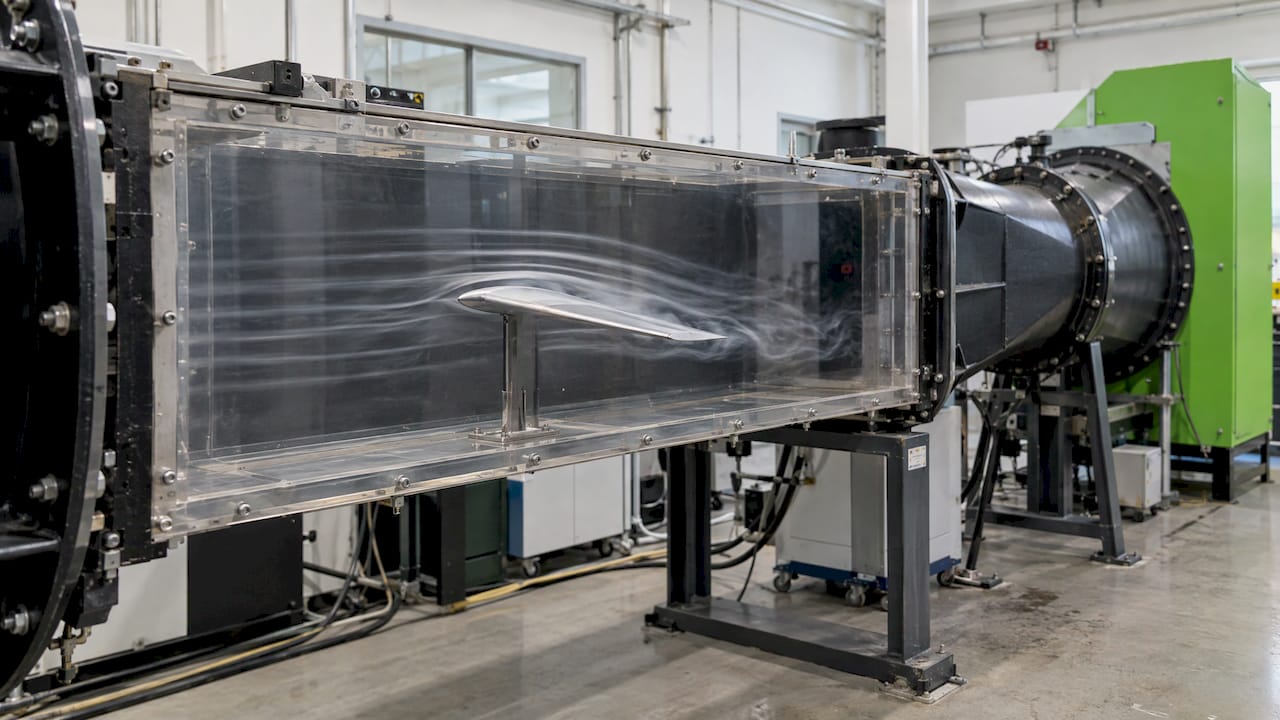
A master’s in aerospace engineering is a specialist degree. The accreditation body for US engineering programs, ABET, sets out what aerospace programs cover. On the aeronautical side, that includes aerodynamics, aerospace materials, structures, propulsion, flight mechanics, and stability and control. On the astronautical (spaceflight) side, it includes orbital mechanics, the space environment, attitude determination and control, telecommunications, space structures and rocket propulsion.
In plain words: you learn how air flows over a wing, how a structure holds up under load, how an engine produces thrust, how a spacecraft stays pointed in the right direction and how it moves around a planet. The work is mathematical and often involves simulation software, lab work or a thesis (a long research project).
The MBA: breadth in how organizations work
An MBA is a general management degree. The American Society of Mechanical Engineers describes a broad MBA curriculum as spanning economics, organizational behavior, marketing, accounting, finance, strategy, operations, and information-technology management.
Translated: you learn to read a balance sheet, price a product, decide which project deserves funding, manage people who disagree with you and plan how a company competes. You also learn how to explain a technical decision to someone who controls the money.
The real difference in one sentence
The master’s teaches you to solve a harder engineering problem. The MBA teaches you to decide which problems the organization should solve at all, and how to pay for them.
Aerospace master’s | MBA | |
Main focus | Technical depth | Management and business |
Typical subjects | Aerodynamics, structures, propulsion, orbital mechanics | Finance, strategy, operations, marketing, leadership |
Output | Specialist engineer, analyst, researcher | Program lead, manager, executive, founder |
Best for | Wanting to stay hands-on with design | Wanting to steer teams, budgets and strategy |
Careers each degree prepares you for
The U.S. Bureau of Labor Statistics (BLS) says aerospace engineers design, develop, and test aircraft, spacecraft, satellites, and missiles, and may specialize in structures, guidance, navigation and control, robotics, or propulsion. A technical master’s sharpens exactly that kind of specialization.
The same BLS page notes that experienced aerospace engineers, or those with additional education, may advance to technical or supervisory positions, including engineering manager or project management specialist roles. That second path is where an MBA does its work. Engineering management and project management are business jobs wearing technical clothes: schedules, contracts, risk, headcount and customer relationships.
A rough guide:
Master’s route: propulsion engineer, structures analyst, guidance and control specialist, research and development scientist.
MBA route: program manager, product manager, engineering director, business development lead, technology strategist, founder.
Neither path is closed to the other. Plenty of leaders hold a technical degree first and add management training later. The question is which one you need next.
How long each takes and what admissions expect
Program lengths and entry rules vary by school, but the typical pattern is clear.
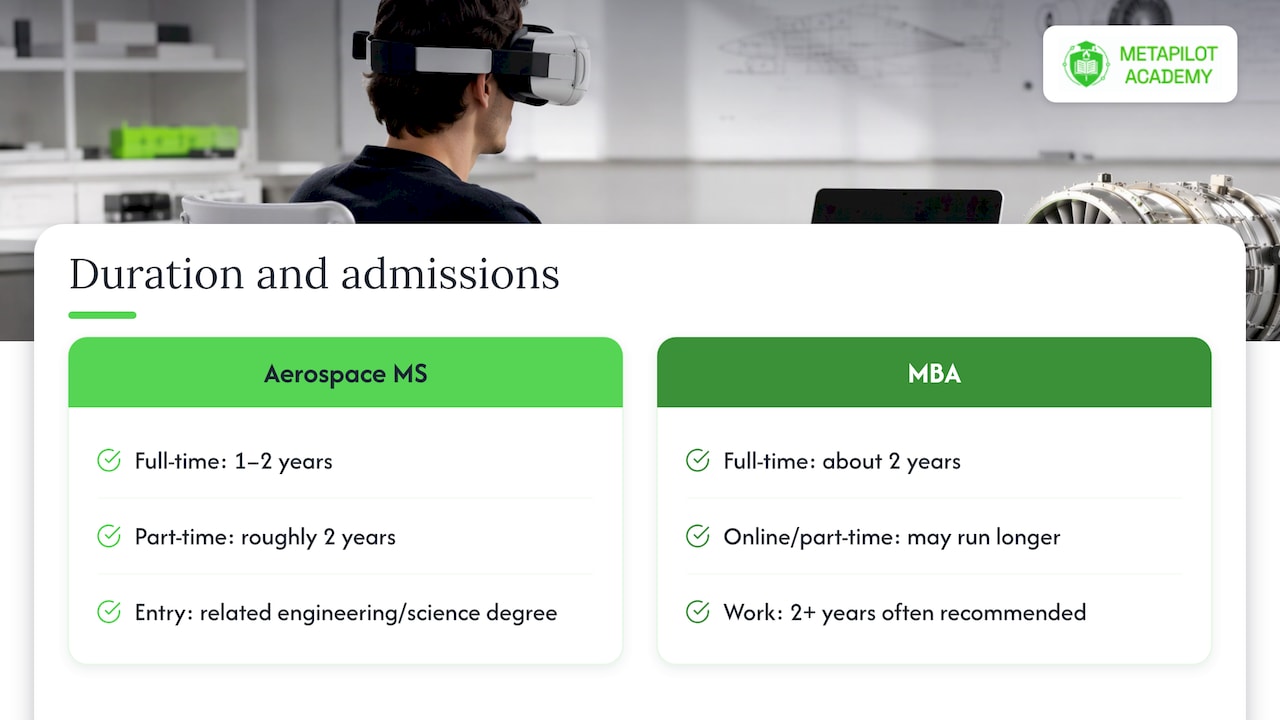
Aerospace master’s. Many US programs are built around 30 credit hours, which is roughly two years part-time or one to two years full-time. Admissions usually expect an undergraduate degree in aerospace, mechanical or a closely related engineering or science field, a minimum grade point average (often around 3.0 on a 4.0 scale) and recommendation letters. Applicants from other fields are sometimes asked to take a few catch-up courses first. Some programs require the GRE, a standardized graduate entrance test, while others do not.
MBA. Full-time MBAs commonly run about two years, and online or part-time versions can stretch longer to fit a job. Selective programs often strongly recommend at least two years of full-time work experience after a bachelor’s degree, and many do not set a minimum test score. Interviews are common. Your engineering background is an asset here: business schools like applicants who can speak both languages.
The practical takeaway: a master’s is something you can start straight after your bachelor’s, while an MBA gets more valuable once you have real projects to talk about. Always confirm the exact credit load, length and entry requirements on the program’s own page.
Cost and payoff: what the evidence supports
Tuition varies enormously by school, format and country, so no single figure is honest for every reader. What you can do is compare the total cost against the role you are aiming at, and check scholarships before you decide. We collected funding routes in our guide to aerospace graduate scholarships.
On the demand side, the 2025 GMAC Corporate Recruiters Survey, the largest regular survey of employers hiring business school graduates, heard from 1,108 recruiters and hiring managers in 46 countries. It found that 90% of responding employers planned to hire MBA talent in 2025. Those are hiring plans, not guarantees, and the survey reports what employers expect and how they set pay, not proof that the degree alone raises a salary. Treat it as a sign of strong employer interest, and weigh it alongside your own target roles.
A useful way to think about value: ask what the degree lets you do that you cannot do now. If the answer is “design a better turbine blade,” the master’s pays. If the answer is “lead the team that decides which blade to build and sell,” the MBA does.
If you are also weighing the flying side of aerospace, this look at pay for pilots with master’s degrees shows how graduate study can factor into that career track too.
Which fits your career stage
Early career, 0 to 2 years of experience
If you are fresh from a bachelor’s degree and love the technical work, a master’s is the natural next step. It deepens your skills while your coursework is still fresh, and it needs no work history. An MBA at this stage can still work, but you will get less from the classroom discussion because you have fewer real situations to compare against.
Mid-career, 3 to 8 years
This is the sweet spot for the MBA. You have seen budgets slip, requirements change and teams pull in different directions. You are likely being asked to coordinate work, not only do it. We wrote a detailed comparison in MBA or engineering management for 3 to 5 year leadership, and our overview of professional MBA programs explains how part-time formats fit around a job.
Career changers and corporate professionals
If you come from another industry and want to move into aerospace, defense, space or biotech, an accredited MBA gives you a credential recruiters recognize, plus a way to build a new network. If you are a corporate professional wanting to raise your qualifications, an accredited program signals that the training meets an external standard.
Engineers eyeing AI and advanced technology
Here the choice gets more interesting, because the most valuable skills sit between the two degrees. A “microcredential” is a short, focused certificate on a single skill, such as building AI agents (software that can take actions toward a goal on its own, like triaging a support queue or screening data). Pairing engineering knowledge with AI and management skills puts you in the seat where technology decisions are made. Our article on employer-backed AI in aerospace programs covers the one-to-two-year routes engineers take to get there.
A quick decision checklist
Answer these honestly:
Do you want your daily work to be calculations, simulation and design? Lean toward the aerospace master’s.
Do you want to own a budget, a team or a product line within five years? Lean toward the MBA.
Do you already have two or more years of work experience? The MBA becomes much stronger.
Is your target employer or role one that asks for a research-level specialty? The master’s, or later a PhD, may be required. Our guide to careers with a PhD in aerospace covers that route.
Do you want to start a company or lead a technology business? The MBA gives you the finance and strategy toolkit.
Do you want both? Many people do one now and the other later. Start with the one that unlocks your next role.
Why an aerospace MBA is the stronger leadership move
Technical talent is plentiful in aerospace. People who can connect engineering to money, schedules and customers are rarer, and they are the ones promoted into program and executive roles. That is why we think an MBA tuned to aerospace and advanced technology is the best-value step for an engineer who wants to lead.
If that sounds like you, these three guides show what an aerospace-focused MBA looks like in practice: why pursue an MBA in aerospace management, elevating your career with an aerospace management MBA and the journey to an MBA in aerospace.
Perspective: where we see the field going
We built Metapilot Academy for people who want to lead in AI and advanced technology, not just work near it. Our programs are co-designed with top global corporations and research centers, and our practical projects are designed to give you real problems to solve and direct recruitment pathways to the companies behind them. That is why we put the MBA first for engineers who want to lead. The business training gives you the language of finance and strategy, while projects in aerospace, defense, space, mobility and biotech keep your technical credibility sharp. Our admissions process is selective, because we want every cohort to be a network you will still lean on years from now. The tech industry is going through layoffs and rapid change, and that makes the choice feel urgent. We see it as an opening. People who combine engineering, business and AI skills are the ones who level up fastest, and you can build that combination with us. Metapilot Academy Team
Start with the program that matches your goal
Metapilot Academy is an accredited institution based in Barcelona, with MBA, Master’s, Bachelor’s and PhD programs, plus technical certification tracks in AI, neurotechnology, aerospace, defense, mobility, space and biotech. Formats are flexible, online and in person, and scholarships are available to help with tuition. Our listed fees include a one-off joining fee of 1 € and a one-off registration fee of 499 €.
If you are ready to lead, start with the Metapilot Academy MBA and executive programs. If you want a technical specialty alongside it, explore our master’s and certification programs, including the Master in applied Artificial Intelligence, the Master in Neurotechnology and the AAM certification on drones, flying cars and vertiports (AAM stands for advanced air mobility, meaning new kinds of air transport).
[
Browse the options on our programs page and apply when you find your fit.
FAQ
Is an MBA better than an aerospace master’s for an engineer?
It depends on your goal. An MBA is better if you want to move into management, strategy or business leadership, while a technical master’s is better if you want to deepen your engineering specialty. For engineers aiming to lead programs or companies, the MBA usually opens more of those doors.
How long does a master’s in aerospace engineering take?
Many programs total about 30 credit hours, which is commonly one to two years full-time or longer part-time. The exact length depends on the school, whether you write a thesis and whether you need catch-up courses. Check the program page for its credit requirements.
Do I need work experience for an MBA?
Most selective MBA programs strongly recommend about two years or more of full-time work after your bachelor’s degree. Engineers with project experience tend to have a strong story to tell in applications and interviews.
Are MBAs still worth it in 2026?
Employer interest remains strong: in GMAC’s 2025 survey, 90% of responding employers planned to hire MBA talent. Whether it pays off for you depends on the role you are targeting, the program’s network and your total cost, so compare scholarships and formats before you commit.
Can I combine technical and business training?
Yes. Many engineers start with one degree and add the other later, or choose an MBA that includes technical, AI-focused content. Pairing the two is one of the most effective ways to move into leadership in advanced technology.
Sources
Recommended


Comments