
Budget by the Median: 2026 MBA Tuition Costs for Applicants

Most full-time, two-year MBA programs in 2026 carry tuition in a wide range, with total cost of attendance varying significantly depending on program and city. The number that actually matters isn’t tuition. It’s cost of attendance (COA), because that figure drives your financial aid ceiling and your real monthly burn rate. Elite programs skew the averages upward; the median candidate pays far less than the headlines suggest.
TL;DR:
The total cost of attendance for an MBA in 2026 often exceeds $200,000 at top programs, primarily driven by city living expenses rather than tuition alone.
Costs include housing, food, health insurance, and personal expenses, which can vary widely between city and program tiers, affecting your budget significantly.
Merits scholarships and employer sponsorship can reduce net costs, but students should verify specific aid eligibility and sponsorship terms early in the application process.
Calculating true ROI involves considering opportunity costs such as lost salary and post-graduation earnings, which can add substantially to the economic burden beyond sticker prices.
Table of Contents
What MBA tuition costs really cover (and what they don’t)
Tuition is one line item on a much longer bill. When schools publish cost of attendance, they’re accounting for everything a student needs to survive the program, not just the classroom seat. That distinction is why two applicants can look at the “same” degree and see wildly different numbers.
A complete cost of attendance figure typically includes:
Tuition and mandatory fees — the direct charge for instruction and program access
Health insurance — often mandatory unless you can show comparable coverage
Housing — usually the single biggest swing factor between programs
Food — budgeted per academic year, not per calendar year
Books and course materials — smaller than people expect, but real
Transportation and personal expenses — the catch-all category schools estimate conservatively
Schools report these numbers as academic-year budgets, and you’ll see both one-year and two-year totals depending on the page. That inconsistency trips up a lot of applicants comparing programs side by side. It matters for another reason too: most institutional financial aid is capped at cost of attendance, meaning you can’t borrow or receive aid beyond what the school certifies you need. If your actual spending runs higher than their estimate, that gap comes out of your own pocket.
What a real 2026 MBA budget looks like, line by line
Numbers become useful once you see them broken into a full year of living, not just a tuition invoice. Here’s how two different program tiers translate sticker tuition into full cost of attendance for a single academic year.
Institutional pages like Wharton’s tuition and financial aid breakdown show exactly this kind of itemization, and it’s worth pulling up the actual page for any school on your shortlist rather than relying on secondhand estimates.
What these tables never show: enrollment deposits (often $1,000 to $3,000, non-refundable), relocation costs if you’re moving cities, visa fees for international students, and dependent care if you’re bringing a family. Run your own numbers through the school’s net-price calculator before you assume the published average applies to you. These tools ask about your income and aid eligibility and spit out a personalized estimate that’s usually more accurate than the sticker price.
How MBA program costs shift by tier and location
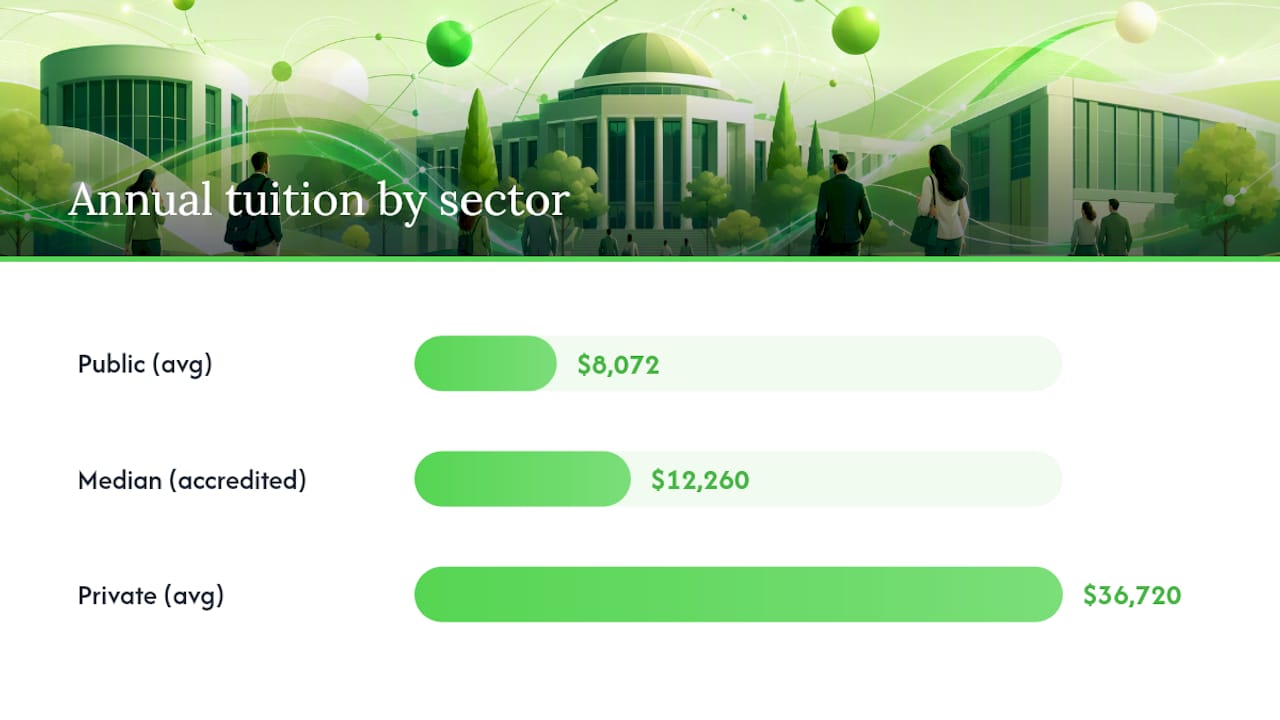
Average and median tell two very different stories, and confusing them leads to bad budgeting. A handful of ultra-expensive M7 and T15 programs pull the “average” tuition number upward, while the median across accredited programs sits closer to $12,260 a year, with public programs averaging around $8,072 and private programs around $36,720. If you’re not applying to a top-15 brand-name program, the average you read in most headlines simply doesn’t apply to your situation.
Program type changes the math further:
M7/T15 full-time programs: typically $150,000 to $200,000+ total two-year cost
Private, non-elite full-time programs: often $70,000 to $130,000 total
Public in-state programs: frequently $30,000 to $60,000 total
Online and part-time programs: highly variable, but generally lower because you keep earning while studying
Executive MBA programs: often employer-subsidized, with total costs ranging widely by school and format
Location does as much heavy lifting as prestige. Living expenses in cities like New York, Boston, or the Bay Area can significantly increase total costs over two years, which narrows the gap between a mid-tier program in an expensive city and a top-tier program in a cheaper one.
The number to remember: Many of the top U.S. MBA programs now estimate a two-year cost that exceeds $200,000, and location is a bigger driver of that figure than institutional prestige alone.
GMAC’s tuition data also shows top-20 U.S. programs running meaningfully higher on average than comparable European or Asian programs, which matters if you’re weighing an international option purely on cost.
Where the money to pay for it actually comes from
Reducing your net cost usually comes down to combining a few of these levers rather than relying on just one.
Merit scholarships reward your application profile (GMAT score, work experience, leadership) regardless of financial need, and awards can range from a few thousand dollars to full tuition. Schools like Rice Business report scholarships awarded to a large share of their incoming class, so don’t assume merit aid is rare.
Need-based aid factors in your financial situation and is capped at the school’s certified cost of attendance.
Federal and private loans cover the gap most students still face; simulate your monthly payment before signing anything so the number isn’t a surprise two years from now.
Employer sponsorship covers part or all of tuition in exchange for a post-graduation service commitment, often two to three years.
Assistantships, fellowships, and external scholarships from professional associations, diversity-focused organizations, and industry groups can stack on top of institutional aid.
Pro Tip: If an employer offers to sponsor your MBA, ask in writing whether the payment is treated as taxable income and what happens to the obligation if you’re laid off before your service period ends. Sponsorship terms vary more than most applicants expect, and verbal assurances rarely hold up if your circumstances change.
Calculating your real MBA ROI, opportunity cost included
The sticker price and the cost of attendance only tell half the financial story. The other half is what you’re not earning while you’re in school, and skipping that number is the most common budgeting mistake applicants make.
Calculate your net cost — total cost of attendance minus scholarships, grants, and employer contributions.
Add your foregone salary — two years of lost income for a full-time program. Analyses that include this opportunity cost show the true economic cost of an elite two-year MBA can add roughly $180,000 to $250,000 on top of out-of-pocket totals.
Estimate your post-MBA salary lift — compare your expected starting salary against your pre-MBA baseline, and model both a conservative and an optimistic scenario.
Compute payback years — divide your total economic cost by your expected annual salary increase to see roughly how long the degree takes to pay for itself.
Budget practically once you have that number: keep an emergency fund separate from tuition savings, project a realistic monthly burn rate rather than a hopeful one, and run your loan amortization under a few different interest-rate scenarios before you commit.
How Metapilot Academy approaches tuition and funding
Metapilot Academy offers an MBA program designed to provide industry access and practical project experience that can support career opportunities.
Scholarships and funding opportunities are available through a selective admissions process.
Flexible online, in-person, and executive formats allow students to choose options that fit their circumstances.
Practical, industry-led projects provide valuable experience that may enhance employment prospects.
Format choice alone can swing your total cost significantly, since an online track cuts relocation and city-living expenses that dominate a traditional two-year budget.
In-state versus out-of-state MBA tuition, explained
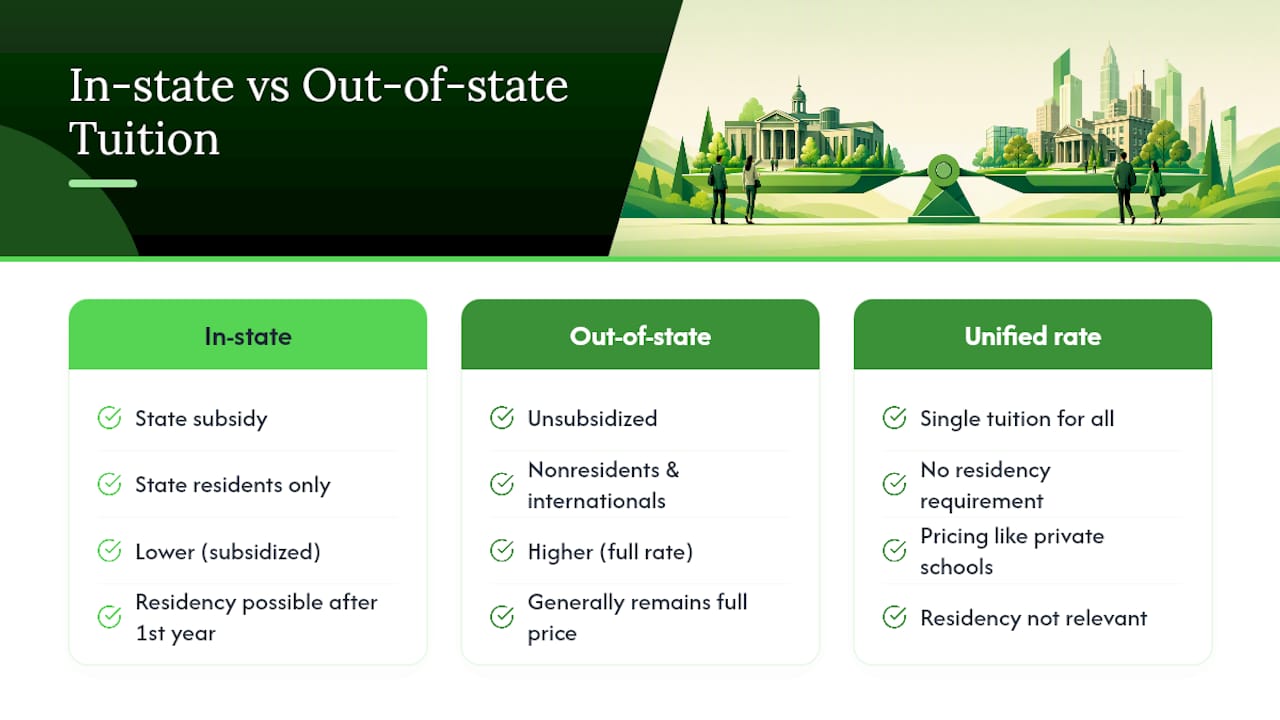
Public business schools set two different tuition rates, and the gap between them is often larger than applicants expect. In-state tuition reflects a subsidy funded by state tax dollars, available only to residents who meet a state’s residency requirements, typically defined by a minimum period of living in the state (often 12 months) before enrollment. Out-of-state students, including most international applicants, pay the full unsubsidized rate.
That gap can run into tens of thousands of dollars over a two-year program, depending on the state and the school. Some public programs offer a path to establish residency during your first year, which can lower your second-year tuition substantially, though the rules for qualifying vary by state and by school, so check the specific requirements before assuming you’ll qualify. A few public programs also charge a single unified tuition rate for their MBA regardless of residency, treating the degree more like a private-program pricing model. This is increasingly common for programs competing nationally for talent.
If you’re comparing a public in-state option against a private program, don’t just compare the two tuition numbers directly. Add fees, and factor in whether the private program’s scholarship pool might close some or all of the gap. A private school offering a strong merit scholarship can sometimes land at a similar net cost to an out-of-state public tuition bill, even though the sticker prices look nothing alike.
Can you actually negotiate your MBA tuition?
Yes, and more applicants should try. Business schools compete for the same pool of strong candidates, and admissions offices have more flexibility on aid than their published numbers suggest.
If you receive a stronger scholarship offer from a comparable program, send it to your preferred school’s admissions or financial aid office and ask directly whether they can match or improve their offer. Many schools will revisit an aid package when presented with a competing offer, particularly if your profile is strong on the metrics they value: GMAT/GRE score, work experience, leadership record, or a background the program is actively trying to recruit.
Timing matters. Applicants who apply in earlier rounds typically have access to a larger unallocated scholarship pool than those who apply in later rounds, when much of the aid budget has already been committed. If your circumstances change after acceptance, such as a job loss or a family emergency, it’s worth asking about a tuition deferral or a payment plan rather than assuming the schedule is fixed. Most schools have some mechanism for this, even if it’s not advertised on the admissions page.
Don’t limit the conversation to tuition alone. Some schools have more flexibility on peripheral costs, like waiving an enrollment deposit or providing a housing stipend, than on the tuition line itself. Ask specifically what’s negotiable rather than assuming the whole package is fixed once it’s offered.
Weighing cost against access: an editorial view
The conventional advice tells you to chase the lowest net tuition. We’d argue the better filter is which program gets you inside real industry projects and recruitment pipelines, since that access changes your payback timeline more than a few thousand dollars in scholarship ever will. If employer sponsorship is on the table, take the time to negotiate it before you take on debt.
— Metapilot
Ready to map your own MBA budget?
Metapilot Academy offers a pricing and plans page to provide tuition and payment information upfront to prospective students.
Metapilot’s MBA program page lays out the curriculum, format options, and how industry partnerships with organizations like Boeing and NASA translate into practical project work. If you’re weighing online against in-person formats to manage cost of attendance, the programs directory breaks down each track so you can compare how format affects your total spend. From there, reach out to admissions for a personalized funding conversation, run the numbers against your own city and income situation, and find out what scholarship or industry-backed support you might qualify for before you commit to a single figure you saw in a headline.
Where these numbers come from
Poets&Quants’ 2026 analysis of two-year MBA costs across top U.S. programs
GMAC’s tuition report comparing top-20 program averages globally
Harvard Business School’s cost of attendance page for institutional COA methodology
CareerReturns’ MBA cost analysis for opportunity-cost and economic-cost modeling
School-specific pages like Wharton’s and Rice Business’s for program-by-program two-year estimates, versus aggregators like Hakia’s statistics roundup for median figures across accredited programs broadly
Sources
FAQ
How much does a one-year MBA cost?
One-year MBA programs vary widely in tuition and cost of attendance, influenced by location and living expenses.
Is an MBA really worth the money?
It depends on your payback timeline: once you factor in opportunity cost, an elite two-year MBA’s true economic cost can add $180,000 to $250,000 beyond tuition, so the degree pays off only if your post-MBA salary lift and industry access justify that gap within a reasonable number of years.
Why is MBA tuition so high?
Tuition reflects faculty costs, career services, and brand reputation, but location often explains more of the total cost difference between programs than prestige alone, since urban housing and living expenses drive much of the gap between programs.
How much does a full-time MBA cost?
Full-time two-year programs range from roughly $30,000 total at public in-state schools to well over $200,000 at top-tier programs once cost of attendance is included, with median accredited-program tuition sitting closer to $12,260 a year, far below the headline averages most rankings report.
What does an MBA at Metapilot Academy cost?
Metapilot Academy’s tuition and fee structure, including its registration fee, is published on its pricing and plans page, where prospective students can review current program costs before applying.
Recommended


Comments