
42 Credit ABET Standard: Pick Defense AI Programs Mapped to NIST RMF

The fastest route into a defense or aerospace AI career runs through an accredited degree or certification, not a generic bootcamp. Pursue a Master’s or PhD if you’re building deep technical expertise, an MBA or executive track if you’re headed toward program leadership, and a microcredential if you need practitioner skills fast. The single factor that separates a career-ready program from a resume filler: whether it teaches trusted-AI practices aligned with the NIST AI RMF and gives you real verification and validation experience, not just model-building theory.
TL;DR:
A defense or aerospace AI career requires an accredited degree of at least 42 credit hours in AI coursework covering foundations, ethics, and system integration, verified by standards like ABET.
Proper TEVV training and mapping coursework to the NIST AI RMF’s core functions are crucial for demonstrating risk-management expertise in high-stakes environments.
Industry-linked capstone projects and employer-sponsored demos significantly shorten job search timelines and provide crucial real-world validation.
Microcredentials offer quick skill boosts but are insufficient alone for core defense or aerospace roles without a foundational degree.
Verify a program’s accreditation, industry connections, and graduate outcomes before enrollment to ensure it prepares you for security clearance eligibility and high-consequence AI work.
Table of Contents
Which AI Programs Actually Lead to Defense and Aerospace Careers
Not every AI degree points toward the same job. The right program depends on where you are now and where you’re headed.
Bachelor’s degree: builds the math, statistics, and programming foundation defense employers screen for at entry level. Expect linear algebra, probability, data structures, and an introductory AI sequence before you touch anything specialized.
Master’s in applied AI: the workhorse credential for engineers who want technical depth without a research career. Programs typically run 1 to 2 years, and you’ll choose between a thesis track (research heavy) or a practicum track (project heavy, often tied to an employer partner).
PhD: built for research scientists and anyone targeting high-assurance system design, where deep expertise in test, evaluation, verification, and validation (TEVV) becomes the job itself, not a side skill.
MBA paired with a technical master’s, or an executive track: aimed at engineers moving into program management, where you need enough technical fluency to direct AI work without personally writing the code.
Microcredentials and certificates: the quickest way to add a specific, provable skill (an AI agent framework, a domain application) without walking away from a current job.
Metapilot Academy’s Master in applied Artificial Intelligence sits squarely in that second category, built for engineers who want project depth on a realistic timeline.
Accreditation and Recognition: What to Verify Before You Enroll
A degree without proper accreditation can quietly cap your career before it starts. Employers in defense and aerospace, and the security-clearance pipelines behind many of those roles, lean on accreditation as their fastest trust signal.
ABET’s proposed criteria for computing programs call for at least 42 semester-credit hours of AI coursework, spanning foundations, machine learning, system architecture, ethics, and a substantial integrative project, plus a defined mathematics and statistics floor. That number matters. A program that can’t account for it in its published curriculum probably isn’t built for the rigor defense employers expect.
If you’re weighing a program with international mobility in mind, check its alignment with UNESCO’s Global Convention on the Recognition of Qualifications, which sets principles for fair, transparent recognition of degrees across borders. Before you enroll, confirm four things:
The accrediting commission’s name and standing, published and verifiable
The specific criteria the program claims to meet (ABET computing/engineering, not a generic label)
Documented graduate outcomes, not marketing copy
A clear appeals or recognition process if credit transfer becomes an issue
What the Curriculum Should Actually Teach
A strong AI curriculum covers the standard technical core: machine learning, deep learning, data engineering, algorithms, AI system architecture, and optimization and statistics deep enough to support serious modeling work. That part is table stakes. What separates a defense-ready program is what happens after the modeling class ends.
Trusted-AI training mapped to NIST’s four core functions. The NIST AI Risk Management Framework organizes responsible AI work around Govern, Map, Measure, and Manage. Programs that map coursework directly to these functions prepare you for the risk-management conversations that dominate defense and aerospace AI roles.
Hands-on TEVV and V&V practice. NIST’s detailed guidance treats test, evaluation, verification, and validation as lifecycle activities, not a final checkbox. Look for labs or simulation environments where you actually run these processes under realistic constraints.
A capstone with teeth. System integration work, simulation exercises, and a demonstration to an actual industry partner tell you more about a program’s rigor than any brochure. The Aerospace Corporation’s own input into NIST’s framework development reflects how seriously mission-assurance culture takes this kind of validation, and programs that echo that seriousness in their capstones are doing it right.
Systems engineering and leadership coursework. Even a technical Master’s should touch program-level thinking if you have any interest in leading teams later.
Pro Tip: Ask an admissions counselor to name the specific NIST AI RMF function each core course maps to. If they can’t answer without checking, the curriculum mapping is probably marketing language, not a real design.
From Classroom to Clearance: Career Pathways and Employer Access
Graduates from these programs land under titles like AI engineer, autonomy or assurance engineer, TEVV specialist, research scientist, and technical program manager. The title matters less than the pathway that got them there.
Industry-linked capstones and demo days put your work in front of hiring managers before you graduate, often collapsing months off a typical job search.
Employer-sponsored projects double as a live audition. A defense contractor watching you debug a real system learns more about your judgment than any interview panel could.
Ask any program for placement statistics, named employer partners, and specific sponsored-project examples. Vague answers here are a warning sign.
Timeline expectations vary by credential: microcredentials open doors to lateral moves within months; a Master’s typically leads to a role within the first year post-graduation; a PhD trades a longer runway for access to research-scientist and high-assurance design roles.
Many defense and aerospace roles also require security clearance eligibility, which starts with U.S. citizenship or equivalent status depending on the employer and program country, plus a clean background check. Programs with strong employer ties often help students understand clearance timelines early, since the sponsorship process can start well before graduation.
How to Evaluate a Program Before You Apply
Run every program you’re considering through the same checklist, in this order.
Confirm accreditation status directly with the commission, not the school’s own claims page.
Check ABET or equivalent computing/engineering alignment, and ask specifically whether coursework maps to the roughly 42 credit-hour AI guidance.
Look for explicit NIST AI RMF and TEVV coverage in the syllabus, not a single elective buried in year two.
Verify capstone industry linkage with named partners, not “collaboration opportunities” phrased vaguely enough to mean nothing.
Review faculty credentials for real industry or research experience in defense, aerospace, or adjacent high-consequence fields.
Request placement metrics and graduate outcome data, ideally with named employers attached.
Ask about scholarships, funding, and total program cost before you get emotionally invested in acceptance.
Red flags cluster predictably: no accreditation body named anywhere, no verification and validation training in the syllabus, no demonstrable industry projects, and placement numbers the school won’t put in writing.
Pro Tip: If an admissions rep can’t name a single employer that hired from last year’s capstone cohort, ask why. A program confident in its outcomes will show you the receipts unprompted.
The Practitioner’s Case for Accreditation Over Speed
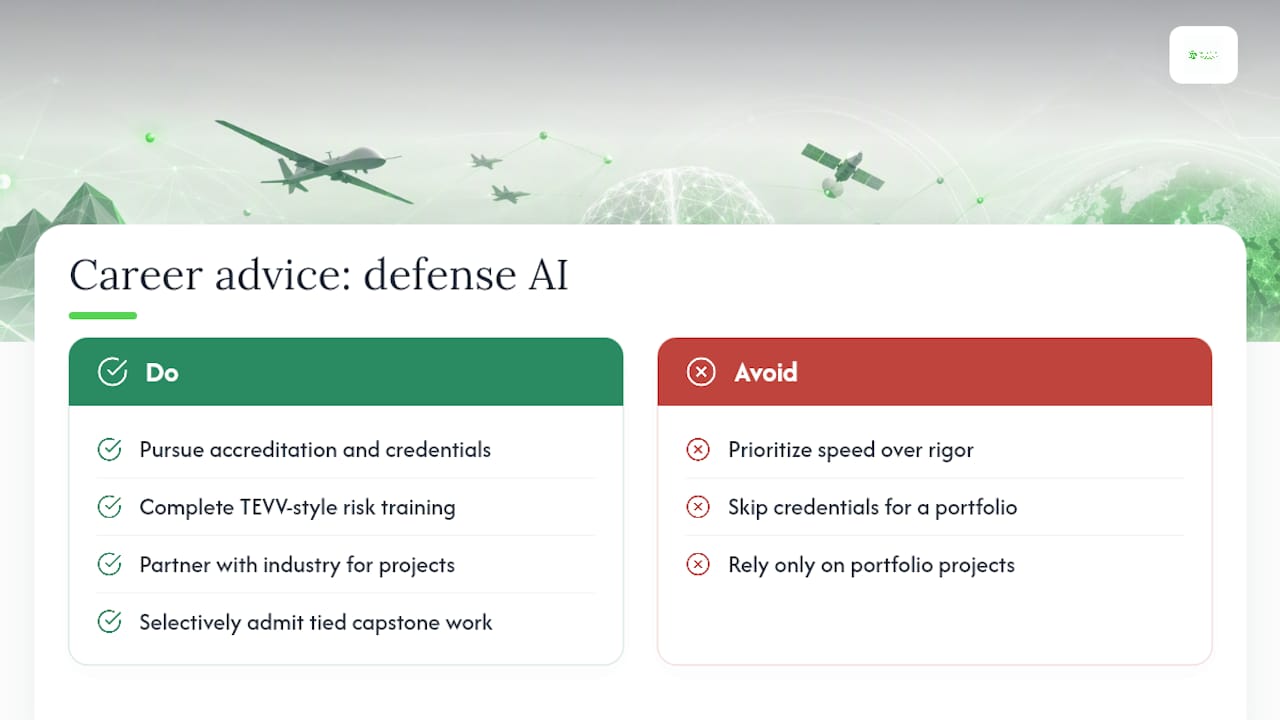
Career advice online tends to push speed, learn fast, ship a portfolio, skip the credential. That advice breaks down the moment you’re building or evaluating AI systems that touch defense or aerospace operations, where a wrong risk assessment carries consequences no portfolio project simulates.
An effective educational model for defense and aerospace AI careers includes real industry partnerships and a selective admissions process tied to capstone project work, reflecting that accreditation and TEVV training are essential job components. Model-building skill gets you in the room. Risk-management fluency keeps you in it.
— Metapilot
Ready to Match a Program to Your Career Goal
An industry-linked alternative to generic online bootcamps for defense and aerospace AI careers includes programs co-designed with major corporations, capstone projects with recruitment pathways, and selective admissions to maintain a valuable network.
[
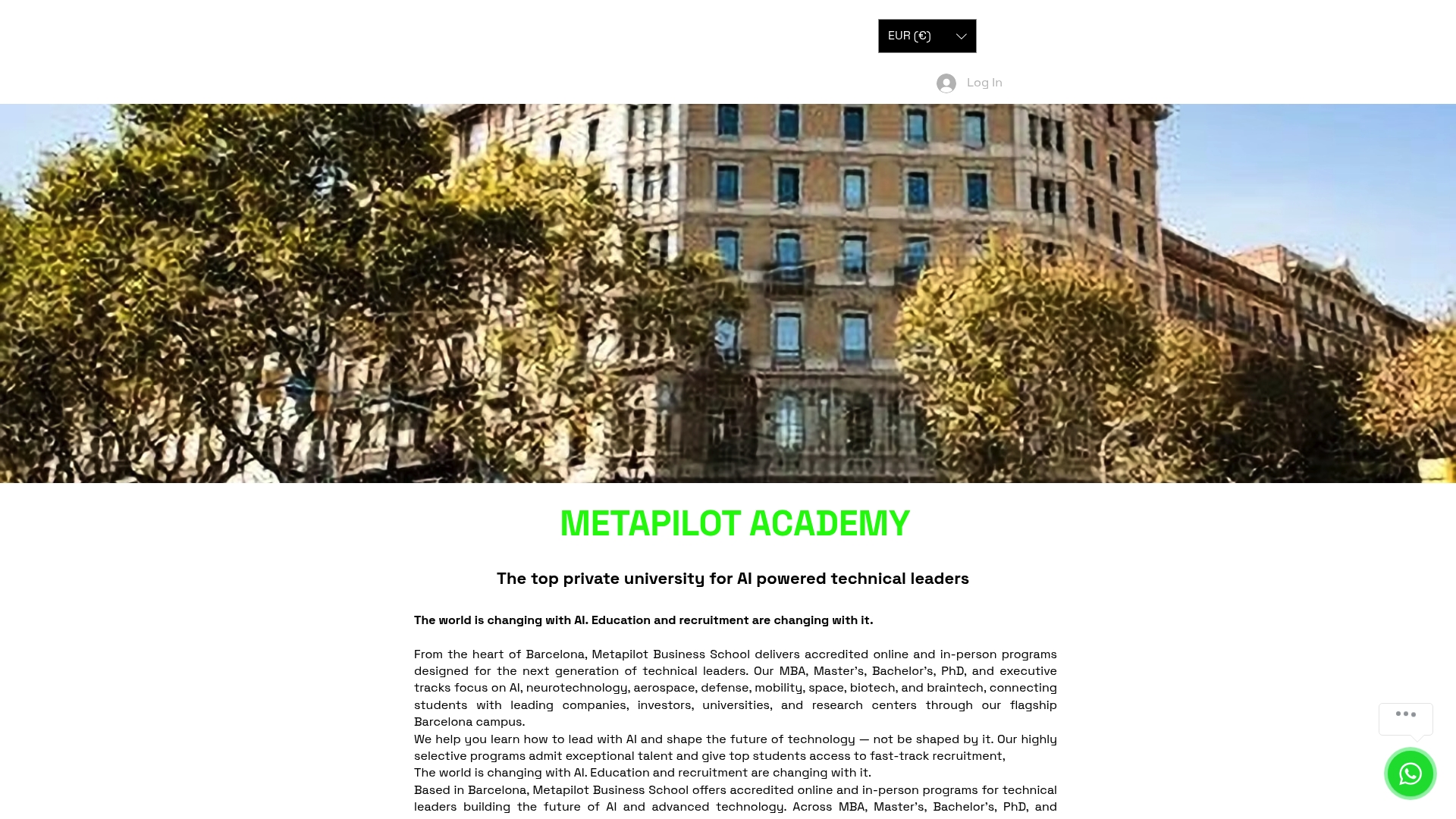
If you’re an engineer building technical depth, the Master in applied Artificial Intelligence or Master in Neurotechnology offer project-based tracks built around real industry problems. If you’re aiming for program leadership, look at the Metapilot Academy MBA or the Metapilot Executive Boardroom track. Researchers targeting high-assurance system design should ask about the Metapilot Academy PhD Program. Working engineers who need a fast, specific skill can explore the full program list, including AI agent microcredentials built for practitioners already employed.
Every program page lists its accreditation statements and curriculum structure, and you can review Metapilot’s accreditation and partner details directly. Pricing and plan details, including the Registration Fee, are listed on the pricing page, where you can also check current scholarship availability. Book an admissions consult through the program list to get a direct answer on which track fits your goals before you apply.
Standards Worth Reading Before You Apply
Cross-check any program’s claims against the source documents: ABET’s computing accreditation criteria, the NIST AI Risk Management Framework, and UNESCO’s quality assurance resources for international recognition. For deeper technical grounding in human oversight design, this practitioner guide on human-in-the-loop AI is worth a read alongside your curriculum review.
Sources
FAQ
What Degree Do I Need for a Defense AI Career?
A Master’s in applied AI is the most common entry point for technical roles, while a Bachelor’s covers foundational entry-level positions and a PhD suits research-scientist and high-assurance design roles. Program managers typically pair a technical master’s with an MBA or executive track.
Does ABET Accreditation Really Matter for AI Programs?
Yes. ABET’s proposed criteria call for at least 42 semester-credit hours of AI coursework covering foundations, machine learning, ethics, and a major project, and employers use that standard as a fast credibility check.
What Is TEVV and Why Do Defense Employers Care About It?
TEVV stands for test, evaluation, verification, and validation, the lifecycle practices that confirm an AI system behaves safely and as intended. NIST guidance treats it as essential throughout development, not a final review step, which is why high-consequence employers screen for it.
How Much Does an AI Master’s Program Cost?
Costs vary widely by institution, format, and funding available. Metapilot Academy’s current pricing and scholarship information is listed on its pricing plans page, including the one-time Registration Fee.
Can I Get Into Defense AI Work With Just a Certificate?
A microcredential can open lateral moves or add a specific skill to an existing career, but most core defense and aerospace AI roles still expect a Bachelor’s or Master’s as the baseline credential. Certificates work best as an addition to a degree, not a replacement for one.
Recommended
Comments