
AI Executive Programs for Program Managers: How to Choose


An AI executive program for program managers teaches you to decide where AI belongs in your portfolio, govern it responsibly and lead teams that build or use it. The best ones combine strategy, risk and data governance with hands-on projects, and end in a credential an employer will recognize. This guide explains what to expect, how to compare options, and how to turn the training into results at work.
We wrote it for program managers, product leaders and senior engineers who are being asked to “do something with AI” and want a practical way to choose. Every technical term is explained in plain words as we go.
TL;DR
A good AI executive program covers strategy, risk, governance and data quality, not only tools. The Project Management Institute (PMI) built its AI standard around the same themes.
AI helps program managers most in forecasting, cost estimation, risk assessment and automating repetitive workflows, but it needs clean data and human review.
Compare programs on five things: curriculum depth, format, who is in the cohort, the credential you earn, and total cost including fees.
Ask how the credential is accredited, meaning checked and recognized by an official or professional body, before you pay anything.
At Metapilot Academy in Barcelona, you can explore MBA, Master’s, PhD and shorter microcredential routes in AI and advanced technologies.
Table of Contents
What an AI executive program actually teaches
An executive program is a course built for working professionals rather than full-time students. It is usually shorter than a degree, aimed at people who already manage teams, budgets or delivery. For program managers, the content tends to fall into four blocks.

Strategy and value. You learn to ask which problems AI should solve and which it should not. PMI’s standard for AI in portfolio, program and project management sets out eight guiding principles, including strategic value, risk, governance and data quality. That is a useful checklist when you read any syllabus: if none of those themes appear, the program may be a tool tour rather than leadership training.
Risk and responsible use. Here you study what can go wrong: biased outputs, wrong answers stated with confidence, leaked data, and decisions nobody can explain. A strong course teaches you to set review points where a person checks the AI’s work. This is often called human-in-the-loop, which simply means a human approves or corrects the machine before the result is used. If you want a plain-language primer, this piece on human-in-the-loop review for AI decisions is a good starting point.
Data and models in plain words. You do not need to write code, but you should understand what a model is (a program that learned patterns from examples), what training data is (the examples it learned from), and what a prompt is (the instruction you give a generative AI tool). Generative AI means systems that produce new text, images or code. Knowing these terms lets you challenge a vendor or an engineering team with confidence.
Change leadership. Tools only pay off when people adopt them. Good programs cover how to introduce AI into existing workflows, retrain teams, update roles and measure results.
How program managers use AI day to day
It helps to see the use cases before you pick a course, because the right program should prepare you for them. PMI’s guide for project professionals says program managers use AI to analyze large datasets for trends, automate quality assurance, predict resource needs and adjust plans dynamically.
Academic research points the same way. A 2025 systematic review (a structured search and summary of earlier studies) covered 97 peer-reviewed papers from 2011 to 2024 and found that cost estimation, duration forecasting and risk assessment were the main applications of AI in project management.
Here is what that looks like in practice:
Program task | What AI can do | What you still decide |
Cost estimation | Compare your project with past projects and suggest a range | Which past projects are truly similar, and what contingency to hold |
Schedule forecasting | Predict likely delays from progress data | Whether to add people, cut scope or move a milestone |
Risk assessment | Flag patterns that preceded problems before | Which risks are real and who owns the response |
Resource planning | Predict demand for skills across projects | How to balance workloads and growth for your people |
Reporting | Draft status updates from raw data | What the steering group needs to hear, and in what tone |
The pattern is consistent: AI proposes, you decide. Programs that teach this division of labor produce leaders who use AI well instead of blindly.
Why data quality comes first
PMI notes that high-quality data governance is essential for generative AI success in decision-making, because performance depends heavily on the quality of the underlying data. Data governance means the rules for who owns data, how it is cleaned, who may use it and how long it is kept. If your project records are incomplete or inconsistent, even the best forecasting tool will mislead you. A good executive program shows you how to audit your own data before you buy a tool. A practical way to start is a simple AI audit checklist your team can run.
Where the research says to be careful
The same review observes that AI tools often show greater accuracy than traditional methods, yet gaps remain in handling dynamic project environments and in validating models with real-world data. In plain words: a model that worked on last year’s projects may not fit a project that changes weekly, and it needs testing on your own data. A good program trains you to run small pilots, compare AI results with actual outcomes and adjust.
How AI executive programs differ
Programs with similar names can be very different. Compare them across these dimensions.
Curriculum depth
Some programs are a few hours of awareness training. Others run for months with assignments and a final project. Check whether the syllabus names real skills you can use on Monday: writing a business case for an AI initiative, scoping a pilot, reviewing a vendor’s claims, setting up governance, measuring outcomes. Be wary of syllabi that list only product names, since tools change quickly and principles last.
Duration and format
Formats include fully online and self-paced, online with live sessions, in-person intensives, and blends. Self-paced suits unpredictable schedules but asks for discipline. Live cohorts give you deadlines and peers. In-person options give the strongest networking. Pick the format you will actually finish. Our own online AI paths are described in this overview of online AI master’s options.
Who is in the room
Cohort quality shapes what you learn. Ask about typical participant roles, industries and years of experience. A program for early-career managers will move differently from one for directors. Many programs expect some work experience and a professional background, but not coding. Check the admission page for requirements such as a prior degree, a CV or an interview.
Credential and accreditation
The credential could be a certificate of completion, a microcredential (a short, focused, verifiable credential in one skill area), or a full degree such as an MBA or master’s. Accreditation means an official or professional body has reviewed the institution or program against set standards. Before you enroll, ask:
Who accredits the institution or program, and can I verify that on the accreditor’s own website?
Will my employer’s tuition benefit or HR team accept this credential?
Does it count toward a later degree?
Is the certificate time-limited or lifelong?
A certificate of completion shows you attended. A degree or accredited program shows you were assessed. Choose according to what you need to prove.
Cost and funding
Prices for executive education vary widely, and many providers publish only a range or ask you to inquire. Compare total cost: tuition, registration fees, materials, travel for any in-person weeks, and the time you will spend away from work. Then look for funding: employer sponsorship, scholarships and installment plans. Always read the official pricing page for the current figures, because fees change.
Choosing by your situation
You manage programs and need AI literacy fast. A short microcredential gives you vocabulary and a working method without a long commitment. Our guide to AI microcredentials for professionals explains how short credentials put responsible AI to work.
You want a formal step up into senior leadership. An MBA with an AI focus signals strategic and financial readiness. See how admissions work in our article on applying to an AI MBA and using AI wisely.
You are technical and want deep specialization. A master’s in applied artificial intelligence or neurotechnology builds expertise in a particular domain. A PhD suits those who want to do original research and lead technical teams at the frontier.
You are a team lead exploring AI project tools. Before choosing a course, it can help to read what an AI project manager tool actually does so that you can judge which skills are about tools and which are about leadership.

A simple scorecard for comparing programs
Score each candidate program from 1 to 5 on the following. Anything below 3 on the first three deserves a hard look.
Criterion | Question to ask |
Governance and risk content | Does it cover responsible use, review points and data quality? |
Applied projects | Will I work on a real problem, not just case readings? |
Credential value | Is accreditation verifiable and recognized by my employer? |
Format fit | Can I complete it alongside my current job? |
Network | Will I meet people and organizations I can work with later? |
Total cost | What do all fees add up to, and is funding available? |
Write down your own weights. A manager seeking promotion may weigh credential value highest, while a founder may care most about network and projects.
Turning training into leadership results
A program only pays off when you apply it. Here is a 90-day plan that works after almost any executive course.
Pick one painful process. Choose something repetitive and measurable, such as weekly status reporting or risk log updates.
Check your data. Confirm the records feeding the process are complete and consistent. Fix what is not.
Run a small pilot. Use AI on one team for four to six weeks. Keep the old method running in parallel.
Add a review step. Decide who checks AI output before it reaches a decision-maker.
Measure against reality. Compare forecasts with actual outcomes. This is the validation step the research says is often missing.
Report honestly. Share what worked, what did not and what you would change. Then scale or stop.
This approach builds credibility with executives, who want evidence, not enthusiasm.
Our perspective
We believe the people who will lead the next decade of technology are the ones who can bridge strategy, governance and hands-on delivery. That is why our programs are built around practical, industry-led projects, not slides alone. We describe our programs as co-designed with global corporations and research centers, with problem-solving projects and direct recruitment pathways for admitted students. Program managers sit at the center of this shift. You translate between executives, engineers and customers, and AI makes that role more valuable, not less. A degree or accredited certification gives you a credential that travels with you, while our shorter microcredentials let you level up your skills while you keep working. We also admit a select group of students on purpose. A focused cohort means more access to demo days, recruitment events and funding opportunities, and a lifelong professional network of people building in AI, neurotechnology, aerospace, biotech and more. If you are ready to lead rather than watch, we would love to meet you. Metapilot Academy Team
Explore programs at Metapilot Academy
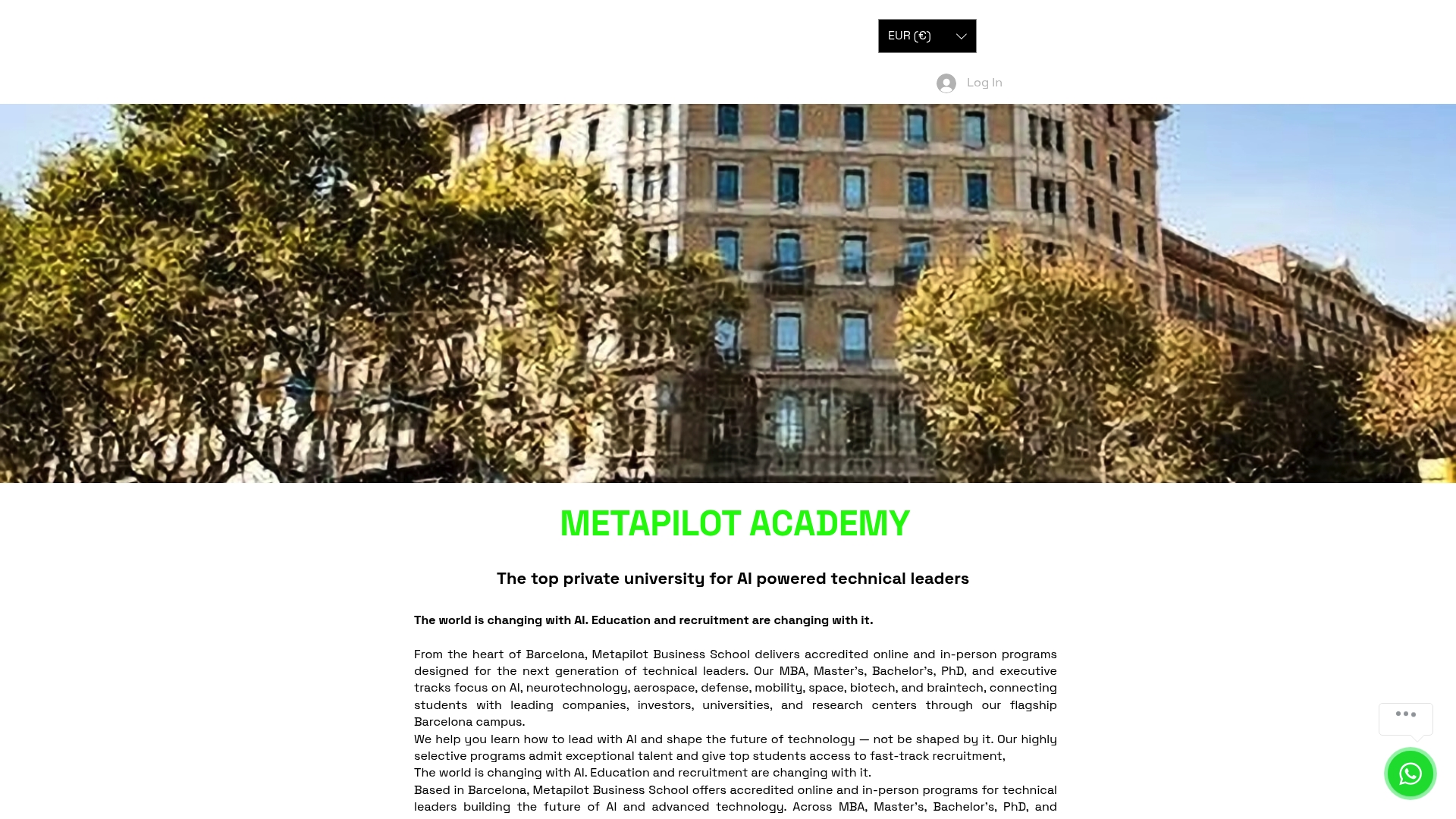
Metapilot Academy is an accredited institution based in Barcelona, offering MBA, Master’s, Bachelor’s and PhD programs, plus AI agent microcredentials and executive education tracks, in online and in-person formats. Our catalog includes a Master in applied Artificial Intelligence, a Master in Neurotechnology, and focused microcredentials such as AI Agents for Recruiters and AI Agents for Sales & CRM. An AI agent is software that can carry out a multi-step task on its own, such as sorting applicants or updating customer records, under human supervision.
[
The published fees we list are a one-off €1 joining fee and a one-off €499 registration fee. Program tuition is not published, so check the current details on the plans and pricing page, browse the full program list, or read about our MBA. Scholarships are available for eligible students, so ask about them when you apply.
FAQ
Do I need a technical background to join an AI executive program?
Usually not. Most executive programs are designed for managers and teach concepts, governance and decision-making rather than programming. You should be comfortable with data and reports, and curious about how models work. Check each program’s admission page for any prerequisites.
How is an AI executive program different from an AI master’s degree?
An executive program is shorter and focused on applying AI in leadership, while a master’s degree goes deeper into technical theory and research and awards an academic degree. If you want to lead AI projects without building models yourself, an executive track or microcredential may be enough. If you want specialist depth, a master’s fits better.
How can I tell whether a credential is accredited?
Ask the provider which body accredits it, then confirm it on that body’s own website. Also ask your employer whether they recognize the credential for promotion or tuition support. A certificate of completion is not the same as an accredited degree, so match the credential to your goal.
What should I do first to prepare for the program?
List two or three real projects where AI might help, and gather the data and process documents tied to them. Having a live problem makes every lesson easier to apply. It also gives you something concrete to bring to a final project or discussion with mentors.
Sources
Recommended
Comments